6.18.2008

A few more late afternoon polls: Obama leads in his second FL poll, but OH is tied

After weeks of not getting a single poll from OH and FL, here is the third Ohio poll in two days -- and a reminder of how much indecision we should expect in polls as long as the race remains a toss-up:

  • Unlike PPP's 11% lead yesterday and Quinnipiac's 6% lead earlier today, Obama is slightly behind in Rasmussen's new poll, though well within the MoE: McCain gets 44% to his 43%, the same margin as the May poll. Obama gets 53% favorability rating against a high 47% (including 31% very unfavorable).
Unless (or until) the election becomes a blowout, it is unlikely that Ohio will ever clearly belong in one or the other camp. This is just a reminder that the election at this point in time remains tight in most of the states that will matter. Meanwhile, ARG released a general election poll from Florida that finds a similar result as Quinnipiac's:

  • Obama is leading 49% to 44%. Both candidates get under 80% from their own party.
  • In case of an Obama/Nelson-McCain/Crist match-up, the GOP ticket is ahead 43% to 42%.
Earlier today, the Quinnipiac survey was the first ever to find Obama leading McCain in the Sunshine state, meaning that the only surveys finding a Democratic advantage were released today. The GOP still has a slight edge in Florida -- Obama is under-organized here and this is a state that resisted the Democratic tsunami fairly well in 2006 -- but the fact that the Illinois Senator looks stronger than expected is a bad sign for McCain's hopes of putting this one away.

Also this evening, ARG released a survey from New Hampshire, another rarely polled state:

  • Obama leads 51% to 39%, including a 15% lead among independents.
  • In the Senate race, Jeanne Shaheen leads Senator Sununu 54% to 40%.
  • And no surprises in the gubernatorial race, as Governor Lynch crushes his minor opposition 65% to 21%.
It is difficult to know what to make of New Hampshire, a state that both candidates have reason to believe they can do well in. The state's large independent contingent swung dramatically towards the Democrats in 2006, a pattern that should at least somewhat hold this year. But New Hampshire has long been kind to McCain, saving him from the dead in 2008 and grant him an unlikely blowout victory against George Bush in 2000.

McCain won both of these contests based on his strength with independents and he hopes to win them over against Obama -- just as he did in on January 8th. Remember that more than expected independent voters chose to participate in the GOP primary instead of the Democratic one, allowing Clinton to upset Obama and McCain to distance Romney. But ARG's poll suggests that McCain's long relationship with New Hampshire and its independents could snap this year. This is one of the two Kerry states that Republicans believe they can pick-up the most (along with Michigan) and putting it away early would be great news for Obama.

Labels: , , , ,

Wednesday polls: Strong day for Obama who leads big in PA, OH, WI and ME and within the margin of error in VA and FL

Quinnipiac released its eagerly anticipated set of swing state polls, and after two weak showing by Obama in the waves of early April and mid-May, he has improved significantly over the past month by solidifying the support of registered Democrats. Though his lead in all three of these states is inferior to where Clinton stood last month, it still represents a significant shift towards the Illinois Senator:

  • In Florida, Obama is ahead 47% to 43%. He trailed by 4% in May.
  • A month ago, he trailed among independents and got 71% of the Democratic vote. In June, he leads indies by 10% and has the support of 82% of Democrats. 19% of those who voted Clinton in the primary would choose McCain, however.
  • In Ohio, Obama leads 48% to 42% -- no doubt boosted by Bush's dismal approval rating of 22%! He trailed by 4% in May.
  • He has improved his share of the registered Dem vote from 69% to 80% and trails by 3% among independents. Among Clinton voters, however, he only leads 63% to 25%.
  • In Pennsylvania, finally, Obama crushes McCain 52% to 40%. He led by 6% in May.
  • Obama gets 78% of registered Democrats compared to 71% in May. He leads by 11% among independents, though his support among Clinton voters remains tepid (66% versus 24% for McCain).
This seems to be the first Florida poll to ever find Obama ahead of McCain, too early, then, to know whether something is actually changing (this is also the first Florida poll released by any institute since Quinnipiac's last poll a month ago!). But note the uniformity of the bounce in Obama's favor: He has improved by 6%, 6% and 8% in these three states, suggesting about the same size bounce that we witnessed in Rasmussen and Gallup's tracking. The margin has narrowed again in those trackings and that we will have to wait for confirmation that Obama has jumped up in those states from other surveys (PPP yesterday showed Obama up 11% in Ohio). Also, black support in favor of Obama is particularly strong and is what is helping the Democrat create some space: He gets between 90% and 95% of the African-American vote, much stronger than what Kerry got in 2004.

As Quinnipiac points out, no candidate has won the election without at least two of these three states in 48 years, so for Obama to get even two would make the road to the White House very difficult for McCain. However, Michigan now appears to be just as competitive as these 3 states and muddies the equation a bit, as picking up Michigan could help McCain offset the loss of Ohio. Meanwhile, a number of other polls were released today from other crucial states that Obama seems intent on contesting:

  • First, Zogby's latest national poll shows the Democrat leading 47% to 42%. Other good news for Obama: he leads by 22% among independents. The bad news: He is only ahead 54% to 44% among Hispanics and 54% of respondents say he does not have the experience to be president.
  • In Virginia, PPP finds Obama edging out McCain 47% to 45%. He gets 78% of Democrats -- a strong showing in a Southern state.
  • In Wisconsin, SUSA finds Obama ahead 52% to 43% -- up from a 6% lead in May. This includes the support of 91% of registered Democrats (!) and a 23% lead among women.
  • SUSA also continues to provide completely useless VP pairings: Which poll respondents has ever heard of Carly Fiorina?
  • In Maine, Obama crushes McCain 55% to 33%, up from a 13% lead last month in a new Rasmussen poll. There's no breakdown by congressional district but with this sort of lead there is no doubt Obama is ahead in both.
  • In Alaska, finally, Rasmussen continues to find competitive races, with McCain ahead 45% to 41%, down from a 9% lead last month.
  • McCain and Obama have comparable favorability ratings (58% to 53% rspectively) but the enthusiasm level really varies, both among very favorable opinions (29% Obama and 18% McCain) and very unfavorable (31% Obama). This is a pattern we are seeing in many red states.
Wisconsin's lead confirms other polls we have been seeing and my hypothesis that the "Dukakis 5" states are coming home, slowly removing 5 blue states from the list McCain can contest. The Alaska poll is stunning, of course, though it is unclear how much the campaigns will look in that direction (it is rather far, after all).

And I have resolved to no longer express wonder and amazement when a Virginia poll shows a tie or Obama narrowly ahead, as every poll recently released from the Commonwealth shows that result -- including one released early this week. That the state's 13 electoral votes are in play are a nightmare for McCain as they expand the map in a region the GOP has long not had to defend. With Mark Warner set to destroy Jim Gilmore, there could even be reverse coattails -- as the PPP poll confirms:

  • This Senate race is no doubt polled so much because Virginia is competitive at the presidential level, but we are still waiting for Colorado to be polled this much. PPP finds Warner crushing 59% to 28% and the worst news for Gilmore is that no one is surprised...
  • In more interesting Senate news, Susan Collins continues to slip in Maine. The latest Rasmussen poll finds her ahead 49% to 42% -- under 50% and within single-digits for the first time. Last month's poll, finding her ahead by 10%, was already the tightest the race has ever been.
  • Proving that Collins is in a Chaffee-esque situation of being driven down by her party rather than by her own liabilities, she has a shockingly high 70% favorability rating.
  • In North Carolina, Elizabeth Dole rebounds in a new Civitas poll: Barely ahead 45% to 43% last month, she is now leading 48% to 38%.
  • In another congressional poll from that state, this one from NC-08, Larry Kissell is narrowly ahead of Rep. Hayes 45% to 43% in an internal poll conducted by Anzalone Liszt.
  • This is a district that voted Bush twice (including by 9% in 2004) but Obama leads McCain 50% to 37% (should we take that as a sign that the poll oversamples dems? A 23% swing from where we were 4 years ago is perhaps a bit much).
Maine has long been a disappointment to Dems, as Collins has been ahead by more than 20% in many polls taken since the fall of 2007. But as partisan passions heat up in the coming months it looks like Collins could get dangerously close to being this cycle's Linc Chaffee and suffer from her party's dismal ratings. As Al Franken's situation is worsening in MN, the DSCC would be delighted to get Maine back in the picture. As for NC, Dole is still under 50% in the Civitas poll but this is the second pollster (after Rasmussen) among those that had shown a tied race in May (after Hagan's primary victory) to find that Dole has rebounded. There are clear reasons for that, too: (1) Hagan's primary bounce faded and (2) Dole has been running TV ads over the past few weeks. Still within striking distance for Democrats but no reason to be as euphoric as the DSCC was last month.

Labels: , , , , , , , , , ,

6.17.2008

Tuesday polls: Obama pulls ahead in OH and is competitive in NC, while Franken and McConnell are in trouble

Finally, after weeks of being bombarded by polls from New York, Kansas and Washington State, someone thought to poll the presidential race in Ohio – and it brings welcome news to Obama’s campaign:

  • Public Policy Polling released its first survey in quite a while and it shows Barack Obama trouncing John McCain 50% to 39%. As usual, Obama is weaker among registered Dems (73%) than McCain is among registered Republicans (83%). Obama is leading by 13% among independents, however. As for potential VP picks, respondents seem more inclined to be swayed by Hillary Clinton than by their governor Ted Strickland.
  • Update: A commenter points out that this survey was in the field on the 17th and 18th of May. This is very strange indeed, as it represents more than a 3 week delay... Did PPP not even poll Hillary Clinton against McCain then? At the time, most pollsters did.
A long series of polls showing Obama weak in Ohio or at least significantly underperforming Clinton (including PPP's most recent survey released in March, repeated waves of Quinnipiac's polls and Rasmussen's May poll) was interrupted by SUSA's showing Obama comfortably ahead of McCain mid-May. PPP's poll is the first since then. Given how much care the Obama campaign is putting in cultivating alternative electoral maps that do would not require victory in Florida and Ohio, the state's 20 electoral votes almost seem like they would be a bonus that would all but ensure the Democrat's victory -- though with McCain's apparent strength in Michigan, it is essential for Democrats to contest Ohio to offset a potential disaster in Michigan.

The day's other important presidential poll is the much-discussed ABC/Washignton Post national poll:

  • Barack Obama leads 48% to 42%, a margin that is little moved since ABC's previous poll, suggesting there has been little movement since the Democrat wrapped up his nomination. The WaPo is emphasizing the fact that the two candidates are tied among independents.
  • Another national poll, released by Cook/RT Strategies, shows Obama leading 44% to 40%.
Last week, after the NBC polled found Obama leading by 6%, I criticized the obsession with pointing out that Kerry had never led in NBC polls in 2004 and that Bush had never beeh ahead by that much either. I pointed out that, in many other polls, Kerry had a clear lead in the early summer and that Bush was repeatedly ahead by 9-11% in September. The ABC poll is a case in point: Now, everyone is pointing out that John Kerry had the same lead in an ABC poll taken at this time four years ago. So which is it? Is an Obama lead significant because Kerry never led or significant because he was the favorite? It is important to look at a pollster's trendlines because of methodology and turnout models, but the pollster-specific comparisons of surveys that are four years apart does not seem to me to be particularly helpful.

What is somewhat significant in recently released national polls is that predictions by strategists from both camps that Obama could open a double-digit lead in the weeks after becoming the nominee have not come true, though the Democrat is consistently ahead. But it is the electoral college, of course, that will determine the winner and two important state polls were released today besides Ohio’s:

  • In North Carolina, polls are now consistently showing McCain’s leading hovering around the margin of error. The latest Civitas poll finds him barely ahead 45% to 41%, with Bob Barr polling in at 2%. Last month, McCain was up by 5%.

  • In Minnesota, SUSA finds Obama struggling to pull ahead, coming in at 47% against 46% for McCain. He was ahead by 5% in a poll taken two weeks ago, though that swing is within the margin of error. The big difference is the flip of the indie vote.
It is difficult to imagine North Carolina flipping if a state like Virginia does not, underscoring how close to a blow-out victory Obama would get if he keeps NC this close through November. As for Minnesota, so much for my speculations that Obama might be putting away the “Dukakis 5,” though it’s worth pointing out that most other recent MN surveys finding a more comfortable lead for Obama. But it is SUSA’s Senate poll from this state that has got to worry Democrats:

  • Norm Coleman has opened up a significant lead against Al Franken, 52% to 40%, though this is stable from last month's poll that showed the Democrat trailing 52% to 42%. Franken loses the independent vote 60% to 33%.
  • If Jesse Ventura jumps in the race (it is the second time this week this match-up is polled), Franken trails 41% to 31% with 23% for Ventura. In a sure sign of trouble for Franken, Mike Ciresi, a Democrat who dropped out of the race in February, polls slightly better than him against Coleman: 50% to 40%.
  • Also today, Rasmussen released a survey of Alaska's Senate race, finding Ted Stevens surviving 46% to 44% against Mark Begich, who was narrowly ahead 47% to 45% last month. Other surveys have found larger leads for Begich.
Al Franken has been suffering through months of bad press, as controversies over tax disclosures, a 2000 essay in Playboy and a 1995 joke on rape erupted in recent weeks. Yet, polls found little movement in this (very often) polled race. But SUSA's survey is obviously bad news for the Democratic challenger as it goes along the narrative of a sinking campaign. That Franken polls roughly at the same level as a candidate who has not been campaigning for 5 months suggests that he is now underperforming the level of a generic Democrat.

Update: SUSA just released a fascinating new poll from Kentucky:

  • In the presidential race, John McCain leads Obama 53% to 41%. This is a huge progression from a May poll in which Obama trailed by 24%. Look no further than the vote of registered Democrat, Obama has gone from... 48% to 59%! Still a very low number, but one that is now in line with what you would expect in Kentucky.
  • In the Senate race, however, Mitch McConnell is only ahead of Bruce Lunsford 50% to 46%!
I for one have long remained unconvinced that Lunsford would be a real threat to McConnell, and given how nightmarish he would be for progressives, it is certainly my top wish among GOP-held seats. But this now the second poll that finds Lunsford to be very competitive and there is no doubt that unseating the Minority Leader would be a huge upset. Given that the DSCC is looking for second and third-tier seats to make competitive to have a shot at 60, this is not the last we will hear of Kentucky.

Labels: , , , , , , ,

5.23.2008

Friday polls: Obama polls better in Ohio, dogged by low numbers with registered Dems

As the Democratic primaries are heading towards their conclusion, more polling outlets are releasing general election surveys, leading to a daily drumbeat of interesting results. Today, we ought to start with the two surveys from Ohio and Pennsylvania, among the most important states in the general election:

  • SUSA released one of the first surveys from Ohio that is favorable to Obama for a long time. The Illinois Senator leads John McCain 48% to 39%. Note that the sample contains a very high number of registered Democrats (52%), though it's also important to notice that Obama reaches his highest level of support among registered Democrats in any SUSA poll from Ohio: 76%.

  • This is a poll meant to test VP support, so there is no match-up with Clinton. I will not detail the VP tests, but the range goes from +2 McCain for Huckabee/Rendell tickets to +18 Obama for Pawlently/Edwards tickets.

  • Meanwhile, a Rasmussen poll from Pennsylvania shows Clinton crushing McCain 50% to 39% while Obama is only ahead 45% to 43%. Last month, Obama trailed by 1 and Clinton led by 6.

  • Obama's support among registered Democrats is very low: 63%. McCain and him have comparable favorability levels.
A long series of polls -- cumulating in yesterday's Quinnipiac poll that showed Obama trailing McCain while Clinton crushed him -- suggested that Obama had a big problem in Ohio. This SUSA poll does not fully dispell that notion considering the strange partisan breakdown and the fact that the majority of respondents are registered Democrats. But it also should serve as a reminder that, even if Obama might have electoral maps that are more appropriate for him than the emphasis on OH and FL that could work better for Clinton, Ohio at least still remains competitive and the Obama campaign has enough money to compete there forcefully even while focusing on Virginia and Colorado.

As for Pennsylvania, it merely confirms the series of PA/OH/FL polls I mentioned above that show Clinton polling more strongly than Obama in those states. Yesterday's Quinnipiac poll showed similar results. PA is not a state that the Obama campaign can ignore, to say the least. Not only does it lean more Democratic than OH and FL, but losing all three swing states would make it extremely difficult for Obama to climb back to 270 electoral votes. Meanwhile, two other polls from important swing states were released:

  • In Nevada, Rasmussen finds Clinton polling surprisingly better than Obama given that Western states are supposed to be more welcoming to him: Clinton is ahead 46% to 41% and McCain leads Obama 46% to 40%. Obama only gets 65% of registered Democrats.

  • In New Hampshire, Rasmussen finds both Democrats reversing the April trend and leading McCain. Clinton is leading 51% to 41% and Obama is ahead 48% to 43%. In the all-important (and symbolic, given what happened on January 8th) battle for independents, Obama is ahead of McCain by 11%.
The two Southwestern states (New Mexico and Nevada) and New Hampshire will feautre some of this year's tightest battles, though none of them offer a lot of electoral votes. The Southwstern showdown, however, will be key to future presidential elections, as Democrats need to make gains in the region as their Northeastern strongholds will continue to lose electoral votes.

Note, however, that in both Nevada and Pennsylvania Obama's principal weakness comes from registered Democrats, a phenomenon that we have documented at great length by now but that is nonetheless always surprising to notice. The Illinois Senator will surely rise above numbers like 63-66% support as the party is reunited, but there is no doubt that he will face major difficulties in his efforts to solidify the base. How well he addresses the concerns of registered Democrats reluctant to support him appears to be the key to November.

Finally, three polls were released from states that should safe for one party or the other:

  • In Mississippi, a Research 2000 poll found McCain beating both Dems,54% to 39% against Obama and 55% to 36% against Clinton.

  • In California, Rasmussen finds both Democrats leading, 52% to 38% for Obama and 55% to 36% for Clinton. McCain's favorability rating is at 46%, Obama's at 57%.

  • PPIC also polled California and found Obama with a bigger lead, 54% to 37%, while Clinton's lead was 51% to 39%.

  • Finally, Behavior Research Center finds McCain leading in his home-state of Arizona: 50% to 39% against Obama, 51% to 36% against Clinton.
Democrats should be heartened that all four of their leads in California are double-digits. If California polls show any sign of tightening, Democrats would be forced to spend precious time and resources defending these must-win 55 electoral votes. Meanwhile, McCain's numbers in Mississippi and Arizona are underwhelming. Some around the Obama campaign insist that states like Mississippi could be in play as Obama will boost black turnout, but the internals of the Research 2000 polls show that will come at a price: white voters will turn to the GOP more than they usually do. Obama only got 18% of the white vote in this Mississippi poll.

Labels: , , , , , ,

5.22.2008

Electoral maps: Quinnipiac's "big state" polls find trouble for Obama in FL and OH, SUSA shows him strong in VA

It is hard to deny that general election polls are consistently showing Barack Obama to be weak in Ohio and Florida. The latest Rasmussen polls from those states, which both showed Clinton running significantly better than Obama, led me to consider the implications for Obama's electoral map, and the choice his campaign will likely make to privilege states that they believe will be more receptive to Obama's message.

Today, the latest wave of "big state" polls from Quinnipiac confirms that Clinton's electoral map would have centered on Ohio and Florida in a way that Obama's map will not:

  • In Ohio, Quinnipiac finds that Clinton beats McCain 48% to 41%; Obama trails 44% to 40%. McCain has improved his margin by 3% against both Democrats.
  • Clinton gets 85% of the vote of registered Democrats, Obama only gets 69%. He also trails by a wider margin among independents and does 17% worse among working-class whites.
  • In Florida, Clinton leads 48% to 41% also while Obama trails 45% to 41%.
  • Clinton wins 86% of the registered Democrats vote, while Obama only gets 71%. Obama also trails by a wider margin among independents. In a key measure, Clinton loses the working-class white vote by 2%, Obama by 20%.
  • 43% of Floridians say Obama's association with Wright makes them less likely to vote for him... the same number that says McCain's association with Bush makes them less likely to vote for the Republican nominee!
  • In Pennsylvania, Clinton leads McCain 50% to 37% while Obama is ahead 46% to 40%. McCain has improved his numbers by 1% and 3% respectively.
  • Clinton gets 86% of the registered Democratic vote, while Obama gets 73%. This is one state in which Clinton looks much weaker among African-Americans, as she gets only 78% of the black vote as opposed to 94% for Obama.
These polls might be used by the Clinton campaign to bolster their electability case to superdelegates. But there is no reason to believe that superdelegates will be affected: We have known for a long time that Obama and Clinton's electoral maps would take different forms, and that Ohio and Florida would be more important for the Clinton campaign. Furthermore, with the competitive part of the Democratic primary over, these polls are certainly more important for what they tell us about the coming general election.

In short, I would like to frame the conversation in terms of electoral maps rather than electability.

A problematic area for Democrats is that both candidates lose the independent vote in Ohio and in Florida. Independents massively turned to the Democratic Party in 2006 and it is that choice that allowed the party to make gains in the midterms. When asked to rate Bush's performance or in down-the-ballot polls, independents are still behaving as Democrats. But McCain is able to stop his party's bleeding and hold on to a lead in two of the major swing states against either Clinton or Obama.

For Obama, these numbers are one more reminder that he cannot take the vote of registered Democrats for granted. Some argue that these are just disaffected Clinton supporters who will easily return home once the nominee is chosen. There is no doubt that some of them will, and that Obama certainly has the capability of capturing the support of most Democrats who are reluctant to support him. But it would be a grave mistake to assume that registered Democrats will back the party's nominee no matter what. They have left the party in the past, and the appeal to (1) conservative Democrats and (2) Hispanics lies at the heart of McCain's electability.

The Obama campaign will have to spend a significant amount of time and resources solidifying the Democrats' blue-collar base and Hispanic supporters, especially if he wants to keep Ohio and Florida competitive. The good news is that a secure and unified base might be enough to win this election: More voters are identifying themselves as Democrats than they have in a long time, and if Obama is trailing by only 4% with weak showings among registered Democrats it does suggest that the answer lies with Democrats rather than at the center or in attracting Republicans.

And just in time to confirm that Obama's campaign is looking to emphasize other states and construct a different electoral map, SUSA released a poll from Virginia:

  • In this red state, Obama leads McCain 49% to 41%, including a 66% to 27% lead in Northern Virginia.
  • This is a poll testing VP choices, so Clinton is not included and you can check all the VP choices here. As always, the best Democrat by far is John Edwards as he bolsters Obama's numbers among registered Democrats, but that is also a name recognition factor.
Some Democrats worry that replacing OH and FL by states like VA and CO might be risky considering that these states have not been kind to Democrats in presidential elections in the past. But polls like SUSA's confirm that Obama does have an opening in those states (a poll yesterday showed Obama trailing by 8% in VA, but the numbers looked weird considering how weak the Democrat was in NoVa). You can be sure that this is a debate that will be waged for the coming weeks, as the Obama campaign tries to settle on a general election strategy. But whatever map they choose to go with they will have to move to secure the Democratic base -- perhaps not with John Edwards's inclusion on the ticket, but some strategy will have to be devised.

Labels: , , ,

5.19.2008

Considerations on the electoral map, given Obama's consistent weakness in Ohio

The question of what to do with Florida and Ohio will be a very important strategic decision for Democrats if (and when) Obama becomes the nominee. It is true that Obama could change the electoral map by putting new states in play like Colorado and Virginia and securing Washington and Oregon more than Clinton could, but that is not a luxury as much as a necessity given Obama's relative weakness in the usual (big) battlegrounds of Ohio and Florida where the past two presidential elections played out.

Today, Rasmussen found mixed news for Obama in the state that sank Kerry four years ago. The Democrat progresses since last month but he gets 44% to McCain's 45%. Clinton, meanwhile, leads McCain 50% to 43%. Clinton has the highest "very favorable" rating. This actually confirms the past two major polls released from the Buckeye state:

  • The latest Quinnipiac poll shows Obama trailing McCain by 1% while Clinton leads by 10%.
  • The latest SUSA poll shows Obama trailing McCain by 2% while Clinton leads by 11%.
The same situation exSo should Democrats keep Ohio as a priority if Obama is the nominee? Or should they concentrate on another path to 270 electoral votes, a path that goes through Virginia, Colorado, New Mexico, Iowa and perhaps even other red states like Nebraska, Alaska and North Dakota? The two strategies are not mutually exclusive, of course, and neither would guarantee victory. But they also suggest two different approaches to the general election.

Proponents of concentrating on Ohio and Florida argue that it would be a huge gift to McCain to consider those states as lost; after all, they represent 47 electoral votes and would allow McCain to move the battlegrounds as well away from what Bush has had to defend in the past two elections and towards states that he interested in contesting like Wisconsin, New Hampshire and Oregon.

Proponents of a new electoral map respond that Democrats have created too narrow a field of possibilities for themselves, putting themselves in the difficult position where a tight loss in the one contested state amounts to losing the entire election -- just like it happened to Al Gore and John Kerry. Also, they consider that too much resources is spent on Ohio and Florida, hindering a broader strategy that would allow more Democrats to proper in down-the-ballot races as well.

Recent polls from Ohio and Florida suggest that Obama would be better served by not relying that much on Ohio and Florida. His relative weakness among blue collar voters, Hispanics and old voters (and some say Jewish voters though that remains to be demonstrated) make these two states less fruitful to him than to other Democrats.

But -- and this is the key promise of the Obama candidacy for Democrats -- the Illinois Senator will have a lot of funds. Even if he looks elsewhere than Ohio and Florida and spends less time in those states than Gore and Kerry did, he will be able to spread his forces and run ads in those states and be ready to pounce if McCain shows any sort of vulnerability.

Labels:

5.01.2008

Obama suffers from worrisome wave of polls

In the first days of the initial Wright controversy back in mid-March, Barack Obama suffered a terrible polling day in which he plunged in a series of 9 catastrophic polls. While today's polls are not quite as traumatizing, Obama is consistently found to be losing ground both against Hillary Clinton and against John McCain, suggesting once again that Obama's support declines the more Wright is in the news. Whether Obama's Tuesday press conference ends up helping him, of course, will be determined in the coming days. But with a Clinton campaign ready to exploit any sign that Obama has an electability problem, numbers like these (and from respected pollsters like Quinnipiac) will not make Obama's already difficult week any less painful.

First, on to the primary polls from the two May 6th states:

  • Rasmussen's tracking poll shows Clinton taking a narrow 46% to 44% lead, a 10% swing in the past two days and the first time she is ahead since April 13th.
  • Gallup's tracking today also finds Clinton gaining ground, now leading Obama 49% to 45%, the first time she is ahead by more than 1% in quite a while. In the general, Clinton now runs 4% better than Obama as she is tied while he trails by 4%.
  • In what is the best polling news for Obama today, the race in Indiana remains close, with Clinton up 46% to 41% according to Rasmussen's poll conducted on Tuesday night. Clinton only gets 4% (!) of the black vote (she can explain a bit more on Tuesday) and leads among whites by 19%.
  • Update: A second poll from Indiana released this afternoon by IN-based TeleRsearch has Clinton leading by 10%, 48% to 38%. She also improved her number as the days passed, in another confirmation that the week-end was rough on Obama.
  • Now comes the North Carolina shocker: Insider Advantage finds Clinton ahead, 44% to 42%! Clinton was merely trying to keep the race competitive -- read single-digit -- and now a poll has her leading. That's a 17% swing in Clinton's favor since the last IA poll.
  • Now, keep in mind that the internals suggest that the picture is not as rosy as this for Clinton: Obama only gets 65% of the black vote, which is also somewhat underrepresented; accounting for that, Obama would undoubtedly in the lead. But the trendline among white voters is also very significant, as Clinton has increased her margin by 14%, so a large part of the 17% swing is due to this shift.
  • Mason-Dixon releases its own poll from North Carolina, finding Obama ahead 49% to 42%; this survey is more in line with previous polls and it confirms that Clinton has managed to push the race down to single-digits. A few days ago, a loss by 20% or more looked quite possible.
As long as Clinton wins in Indiana, she would be able to use a narrow loss in North Carolina to her advantage, for such a result would be one of the most (only?) unexpected results of the past few weeks, in a primary season in which both candidates have struggled to break each other's serve. But Clinton might regret these polls if they shift expectations in the next few days; there are enough days until Tuesday's primary for the media narrative to change away from NC being an expected blowout for Obama to "will he break double-digits?" This is, of course, exactly what happened in Ohio and Pennsylvania.

Meanwhile, a series of general election polls also paints a troubling picture for Obama who has lost his edge relative to McCain in four polls taken in crucial swing states:

  • Rasmussen polls New Hampshire and finds McCain leading against both Democrats. But , while this is a state in which Obama usually far outpaces Clinton, he loses by 10% (51-41) while Clinton trails 47% to 44%. Last month, Obama trailed by 3%; two months ago, he led by 13%.
Quinnipiac released its monthly wave of polls from the "Three Big States" (FL, OH and PA):

  • In Florida, Clinton beats McCain convincingly, 49% to 41%. Obama trails 44% to 43%. This is an improvement for both Democrats; last month, Clinton only led by 2% but Obama was crushed by 9%.
  • In Ohio, Clinton reaches double-digits against McCain, 48% to 38%, while McCain narrowly edges out Obama, 43% to 42%.
  • In Pennsylvania, however, the prolonged exposure both Democrats got appears to have helped their cause. Clinton crushes McCain 51% to 37%; Obama gets a large lead as well, 47% to 38%.
  • The big difference comes among white working-class voters: Clinton is tied in FL, leads by 6% in OH and by 8% in PA among this group of voters. Among this same group, however, Obama trails by 17%, 15% and 7%! That's quite a large differential with Clinton.
  • Obama also suffers from his usual problem among registered Democrats; in Florida and Ohio, he only gets 69%. His edge relative to Clinton among independents is not as large as usual.
If I was looking at these numbers exclusively from the point of view from the general election, they could certainly be spun in a very different light: After a very difficult month, bitter-gate and Wright (the second wave of Wright is not included in these polls), Obama is tied with McCain in OH and FL and he has opened up a large lead in Pennsylvania, most probably thanks to the millions he spent on PA television in the run-up to the primary. Combined with Clinton's showing, the PA results are very good news for Democrats; the Keystone state is one of the most important swings states that they cannot afford to lose. Kerry and Gore spent a lot of time and money there, and it would be a huge boost if the Dem nominee did not have to do the same this year. The fact that McCain is not able to benefit from McCain's troubles suggest that Republicans might have a very difficult time finding competitive numbers for a while after the Democratic primary is over.

Viewed through the primary lens, of course, the NH and Quinnipiac polls are the ideal set of results Clinton would have designed herself: She has somewhat managed to open a large lead against McCain in all three states (it is very difficult to imagine a Democrat losing despite winning all three of these states), and her electability advantage comes from Obama's weakness among working-class whites, the group among which Obama is consistently weak. (Predictably, Kos's latest post hits Clinton for being "weaker across the board" by cherry-picking the surveys released in the past few days and only including... the New Jersey poll released yesterday by Monmouth University. No mention of Quinnipiac).

This is to say that these numbers are not random nor are they surprising; the constituency that is providing Clinton with an advantage here is one in which she always performs better. But in other states with different demographics, it is Obama who is stronger in the general election -- states in which the key swing state are independents rather than working-class whites (CO, OR and NV, for instance) are much more likely to be picked up or held by him. More than ever, the two Democrats represent two very different electoral maps.

Labels: , , , , ,

4.17.2008

SUSA releases wave of general election polls, with both Democrats displaying their usual weaknesses

On March 19th and March 20th, SUSA released 16 general election polls that recorded public opinion in the aftermath of the Wright controversy; in many states, Obama was found to be plunging due to his continued weakness among registered Democrats and to the departure of independents and registered Republicans.

A month has passed, and SUSA released 14 general election polls from some crucial contests today; there is some good news for all candidates in these polls, but the first thing that jumps at me is the extent to which McCain is holding strong, putting a number of Democratic states in play. Obama leads McCain by single-digits in Massachusetts, New York, and California -- including a toss-up (once again) in Massachusetts.

The two Democrats are exhibiting their usual weaknesses that we notice in poll after poll. Obama has regained some of the ground he lost last month, but his at times stunning weakness among registered Democrats in places like Ohio and Missouri leaves him distanced by McCain (and Clinton). This is also also what is making states like MA and CA competitive. This weakness has been picked up over and over again by SUSA -- but also by other institutes (check the most recent Quinnipiac poll from FL, OH and PA with McCain picking-up a significant number of Dem votes when he faces Obama). However small this problem might seem, it is wrong to simply assume that registered Democrats will come home; the ease with which many Dems cross-over is exactly what Clinton is talking about when she questions Obama's electability and McCain has demonstrated his appeal among Democrats.

Meanwhile, Clinton has her own major problems. First, she comes in at dismally low number among African-American voters in most of these states. I do not always mention the results here since in many states the sample of black voters is too small to be statistically significant, but the trend is too consistent to not be revealing. In places like Virginia, Clinton cannot hope to remain competitive without rallying the African-American vote. Obama supporters, of course, contend that for Clinton to win the nomination would take such an ugly scenario that there is no way the New York Senator could regain the black vote. Second, Clinton does not as well as Obama among independents and registered Republicans in many states; in places like Oregon and Wisconsin, we have been seeing this trend for a while, as independent voters in a number of states (particularly in the West) seem to be among Clinton's harshest critics.

And here is the run-down of the numbers:

  • The most important state polled by SUSA is undoubtedly Ohio, where Clinton opens up a very significant lead against McCain, 53% to 42%. But McCain leads Obama 47% to 45%. That's a 5% shift towards both Democrats compared to last month, when Obama trailed by 7%.
  • Almost all the difference is due to registered Democrats, Obama carries 65%, Clinton 82%. Also, Obama loses the white vote by 12% while Clinton leads, though she underperforms among blacks (73%).
  • In Missouri, Clinton edges McCain 48% to 47% but McCain comfortably is ahead of Obama, 50% to 42%. McCain gets a full 27% of the vote of registered Democrats when paired up against Obama... which accounts for his trailing the Republican despite performing better among independents. This is actually a 6% improvement for Obama, however, compared to last month.
  • In Virginia, Obama performs better than Clinton but suffers from a significant decline: After tying McCain two straight months, he is now behind 52% to 44%. Clinton is crushed 55% to 39% -- she is also tied McCain last month. This is due to Clinton's dismal performance among blacks (60%) while Obama comes in much stronger among independents.
  • Obama's decline in the past month is due to McCain's closing the margin among registered Democrats by 17%.
  • In Kentucky, which is not supposed to be anywhere near the list of purple states, Clinton defies the odds by statistically tying McCain, 48% to 46%. She gets 73% of the Democratic vote. Obama trails 63% to 29% and loses the Democratic vote by a point.
  • It's hard to believe, but that is actually an improvement: Obama lost the Democratic vote by 7% last month, at least suggesting that this is not a complete outlier.
  • In New Mexico, McCain narrowly beats both Democrats: 49% to 46% against Clinton, 49% to 44% against Obama.
  • The two Democrats are equally strong among Hispanics.
  • In Minnesota, Obama leads McCain 49% to 43%; Clinton edges him 47% to 46%. That's a 7% improvement for the Illinois Senator.
  • In Iowa, Obama polls much better -- as usual: He beats McCain 49% to 42%, while Clinton trails 48% to 42%. The difference comes from independents, among whom Clinton trails by 26%!
  • In Oregon, another bluish swing state, Clinton and McCain are in a toss-up, 47% to 46%. Obama comes in much stronger, 51% to 42%. Here again, the difference comes from independents.
  • In Wisconsin, one of the tightest states in the country, Clinton and McCain are tied at 46%. Obama edges McCain 49% to 44%. The difference is very clearly due to independent voters: Obama leads by 1%, Clinton trails by 17%.
The next category are staunchly blue states that are essential to a Democratic victory -- and there are signs of troubles for Democrats, particularly in case of an Obama candidacy. The Illinois Senator looks weak in three states that constitute much of the Democratic base:

  • In Massachusetts, especially, poll after poll have shown Obama weak against McCain: This survey shows the Illinois Senator barely edging out the Republican, 48% to 46%. Clinton crushes McCain 56% to 41%. Most of the difference comes from registered Democrats: Obama gets 65%, and Clinton gets 84%. Believe it or not, this is actually a slight improvement for Obama, who was tied with McCain last month.
  • In California, Clinton beats McCain 53% to 40%; but McCain keeps Obama in single-digits, 50% to 43%. The difference here is first among women (Clinton has a 18% lead, Obama 8%) and both Democrats and independents (McCain actually leads Obama by 2% among the latter group!). That's a 7% drop for Obama over the past month.
  • In New York, the story is very similar: Clinton crushes McCain 55% to 39%, Obama is held to single-digits, 52% to 43%. Most of the difference comes from registered Democrats (McCain trails by 17% less). Obama already led by single-digits last month.
SUSA also released a few polls from red states that aren't competitive at all:

  • In Alabama, McCain predictably crushes both Democrats. He beats Clinton 60% to 34% and Obama 64% to 32%. Only 65% of black voters vote for Clinton, while Obama gets only 15% of white voters.
  • In Kansas, McCain beats Clinton 57% to 36% and Obama 54% to 37%. That's an improvement for the Republican against both Democrats.

Labels: , , , , , , , , , , , , ,

4.10.2008

General election: How much will the electoral map change?

An Obama-McCain general election match-up would ensure that the electoral map we are accustomed to changes; both candidates appeal to states traditionally abandoned by their respective parties, but they are also both dangerously weak among groups previous nominees have carried more easily. Clinton could also transform the map, as she would put in play states that Kerry had given up while having to counter McCain's atypical appeal to blue-leaning independents.

In fact, the conventional wisdom of how the two candidates' strategies differ seems set for the time being: Obama would rely less on states like Ohio and Florida in which he looks to have more difficulty than Clinton and choose a less conventional path to the White House that goes through states like Colorado, Virginia and... the Mountain West, places in which Clinton is much less competitive.

This is of course just a rough sketch that the coming months will allow us to refine; but there is already plenty of evidence of how different the two electoral coalitions that Obama and Clinton are amassing are. Against McCain, Obama is typically stronger among independents and African-Americans, just as in the primaries. Meanwhile, Clinton's general election strength are derived from an edge among blue-collar voters, here again a repeat of her match-up against Obama. Gallup came out with a fascinating study today showing how Clinton and Obama's general election coalitions are almost unbelievably the opposite of one another:

  • The aggregate of Gallup's tracking poll from March 31st and April 6th shows that McCain leads Obama among voters with no college education (46% to 40%). McCain's lead evaporates among voters with any college education, including a 52% to 42% lead for Obama among voters with a postgraduate education.
  • Clinton, meanwhile, performs in exactly the opposite way: Clinton leads among voters with no college education (48% to 43%) but trails among voters with any college education, including a 10% deficit among four-year college graduates and a 3% deficit among voters with a postgraduate education.
Given these dramatic differences, it is hardly surprising that Obama and Clinton are working on different electoral maps, and that the 2008 general election could throw the Bush-Rove map of the past 2 cycles right out the window. Today's wave of general election polls confirms that we will have to pay attention to states that are generally forgotten in general elections:

  • First, a Marist poll of New York shows John McCain not only competitive but actually edging out Obama 48% to 46%. Clinton leads 48% to 46%. In the poll's least interesting but most discussed follow-up, a McCain/Rice ticket would lead both a Clinton/Obama and an Obama/Clinton ticket.
It is hard to know what to make of this poll for the simple fact that it is a complete outlier relatively to all the New York polls we have seen this year. This is not to say that McCain will not make blue states competitive, as there is plenty of polls that suggest Connecticut and New Jersey will be very competitive with McCain on the ballot. But looking at the past few New York polls, there simply is no sign of much vulnerability on the part of either Democrat (Obama leads McCain by 13% and 21% in the past two polls), so we will have to wait for other polls to confirm Marist's finding.

We also got a wave of general election releases from Rasmussen:

  • In Ohio, McCain is leading both Democrats comfortably, 47% to 40% against Obama and 47% to 42% against Clinton.

  • In New Mexico, Obama leads McCain 45% to 42% while McCain is ahead of Clinton 46% to 43%. In late February, McCain tied Obama and led Clinton by 12%.

  • The first surprising results come from Alaska, where McCain only leads Obama 48% to 43% while trouncing Clinton 57% to 32%. Clinton's favorability rating is just 35% far behind McCain (63) and Obama (55).

  • Just as surprising are Montana's numbers: McCain here again only leads Obama 48% to 43%. He is further ahead of Clinton, 54% to 38%.
Both Alaska and Montana are staunchly Republican states where Obama is vastly overperforming the typical Democratic candidates. Note that these states are conservative in a very different manner than in the deep South and its history of racial conflict; the relative absense of racial polarization in the Mountain West makes this region the testing ground of Obama's attempt at changing the electoral map.

Note also that there is a precedent for such numbers in other polls: SUSA's 50-state poll project in early March tested McCain-Obama match-ups in both Alaksa and Montana and found McCain ahead by 5% and 9% respectively. Obama was competitive in many Western states -- and even led McCain in North Dakota! Most of these states are worth only 3 electoral votes, but the last thing McCain wants is to have to play defense in so many small states.

Relatively to the numbers from MT and AK, of course, Ohio's numbers have to be very disappointing for Democrats. This state was supposed to be a disaster zone for Republicans since 2004 and Democrats were confident that it would be much easier for them to pick it up this time. Democrats do not necessarily need Ohio to get to the White House, but the fact that McCain is consistently strong in the state has got to be a painful blow.

Labels: , , , ,

4.02.2008

Quinnipiac polls the big three, uncovering both Democrats' usual weaknesses

Apart from today's fascinating primary polls, there are a number of other surveys that are worth looking at closely, starting with Quinnipiac's latest release of their polls from the general election "Big Three," Ohio, Florida and Pennsylvania. Quinnipiac brings mixed results for Democrats and finds Hillary Clinton polling better than Barack Obama, surprisingly so given that most recent polls have shown the latter outpacing her.

  • In Florida, Clinton beats John McCain 44% to 42% but the Republican leads comfortably against Obama, 46% to 37%.
  • In Ohio, Clinton distances McCain 48% to 39%. Obama edges out the GOP candidate 43% to 42%.
  • In Pennsylvania, finally, Clinton leads 48% to 40% while Obama is ahead 43% to 39%.

  • The first major difference between Clinton and Obama come from the level of Democrats who cross-over to vote for McCain. If Clinton is the nominee, 9% (Florida), 8% (Ohio) and 11% (Pennsylvania) of Democrats vote for McCain. If Obama is the nominee, those numbers go up to 20%, 19% and 17%.
(Update, in response to comments: The issue of cross-over Democrats is not the same as that of the polls that have recently showed that Obama and Clinton primary supporters would not support the other candidate in the general. Those polls show that roughly equal a proportion now say they would abandon either candidate and those who would go to McCain have generally been found to be independents voting in the Democratic primary, not registered Democrats. In these general election polls, however, the cross-over does not affect both candidates equally and these voters are registered Democrats, not independents).

  • Second, Clinton is performing better among the white vote. She gets 38% of whites in Florida, versus 27% for Obama. In fact, McCain beats Obama 2:1 among whites in that state (54% to 27%). In Ohio, Clinton wins white women by 11%, while Obama loses that group by 9%.
  • Also noteworthy is that Obama and Clinton come in with roughly the same numbers among men, and that all the difference Clinton creates is among women. Enough to say Obama's problem are white women Democrat?
  • Obama, meanwhile, does slightly better than Clinton among Republicans and independents. In Pennsylvania, he leads McCain by 9% among indies while Clinton ties. The margin among independents is the same in Florida -- which is also significant given that Obama runs 11% worse overall.
  • As for trendlines, both Democrats have improved in Ohio and Pennsylvania since the last poll in February (when McCain led both Dems in Ohio), but only Clinton improved in Florida.
As always, it would make little sense to draw overarching conslusions about which candidate is most electable based on these polls, except perhaps in the case of Florida as a consensus seems to be developing that Florida is a state in which Obama would struggle more than Clinton, just as there is a consensus developing that Clinton would struggle much more in Oregon, Colorado and Washington.

The general election polls that are coming in do not tell us much about who will win in November, but they are very instructive about what states we can expect to be competitive and, very importantly, what are the weakest points of both Democrats. And here we have been getting a fairly consistent result: Clinton significantly outpaces Obama among registered Democrats despite the fact that she usually is weaker among African-Americans (Quinnipiac did not release the breakdown of the black vote); she also tends to perform better among women. Her advantage among whites in these polls, however, is not something we are accustomed to; given other polls that show Obama putting the Wright controversy behind him, we should wait for other surveys to confirm these results (especially in Florida) to draw conclusions.

Despite his apparent problem with white Democratic women (remember New Hampshire...), Obama outpaces Clinton with equal consistency among independents, usually men (though not particularly in this poll) and gets more cross-overs from Republicans. Depending on which groups a poll has weighted more heavily (what proportion of Dems? of independents?), Clinton and Obama alternatively look stronger.

It is thus significant when one polling group comes out with surveys showing consistently better results for one of the candidates (Quinnipiac today for Clinton, Rasmussen earlier this week for Obama) for that confirms that the main difference between these polls is the turnout model the polling group projects. But pay attention to the internal numbers, for that is where the electability debate will play out: If Clinton is in any position to argue her way to the convention and the electability debate is actually debated in August, will she have improved her position among black voters? Will Obama remain weaker among registered Democrat? And so on.

Labels: , ,

3.19.2008

McCain rises and Obama plunges in series of 9 catastrophic polls for Dems

Rarely have I seen this consistent a turnaround in general election polls: In 9 general election polls released today, McCain is on the rise and Obama declines due to his (1) continued weakness among registered Democrats and (2) the departure of many cross-over Republicans and independents who had come to support his candidacy. Also, Clinton's position generally remains stable, suggesting that it is Obama who is weakening more than McCain who is improving.

Obama's plunge looks particularly vertiginous because of how high he was riding in the last two weeks of February, looking competitive in every poll and beating McCain in many reddish states; so some of the trendlines have to be taken with a grain of salt, since they follow an Obama progression. Also, it looked likely that Obama would not keep up his strong levels of support among registered Republicans and independents once the general election campaign began, the GOP nominee was chosen and the two sides became polarized. But the consistency of the numbers suggests that March belongs to McCain.

All the polls I am about to cite follow PPP's Florida release yesterday that showed McCain up 11% in Florida against Obama. Today, two polls from Ohio show the Arizona Senator strengthened in the red state that until recently looked the most promising for Democrats:

  • SUSA shows Clinton leading McCain 50% to 44%, but McCain leads Obama 50% to 43%. Compared to the previous SUSA poll from late February, that's a 4% Clinton drop and a 17% Obama plunge.
  • In a pattern that we will find in most of these polls, Obama is weak among registered Democrats (he gets 66% to Clinton's 80%) and Clinton is weak among blacks (64%). But the shift in numbers is due to independents deserting Obama (down from 60% to 45%) and Republicans moving home (the margin is 12% better for McCain).
  • PPP's poll also brings good news for McCain, who trails Clinton only 45% to 44% but is ahead of Obama 49% to 41%.
  • Here again, Clinton is very weak among blacks (47%) and Obama among registered Democrats (60%).
The same internals and trendlines can be found in other polls from other states:

  • In Kentucky, SUSA finds McCain leading Clinton 53% to 43% and trouncing Obama 64% to 28%. In the past three weeks, Clinton has dropped by 1% and Obama by 15%.
  • McCain actually wins among registered Democrats when paired up against Obama (48% to 41%); Clinton is up 60% to 31%. The gap among registered Republicans has increased by 18% -- with Obama down to 8%. Independents have shifted by 11%.
  • In Missouri, McCain is leading Clinton 48% to 46% -- a 2% improvement for Clinton in the past 3 weeks. But Obama is trailing 53% to 39%, an 8% decline.
  • Obama is winning only 62% of registered Democrats, versus 83% for Clinton. McCain has closed the gap by 17% among that group against Obama.
In all three of the SUSA polls (MO, OH and KY), Obama and Clinton are now running roughly even among registered Republicans and independents, and the difference in their showing is coming from registered Democrats. That suggests that Republicans are starting to look at Obama as an adversary, and no longer as the candidate who finally defeated a Clinton.

Furthermore, the fact that Clinton is weak among blacks but running so far ahead among registered Democrats confirms that it is white Democrats who are right now deserting the Obama, meaning that it is the racial controversies of the past week have taken a toll on him. This is not good news for the hope that the general election could be civil, for this will likely encourage Republicans to not shy away from racial attacks in the coming months. Whether or not Clinton was actually attempting to do that in the past 2 months, it did not work against the Illinois Senator in the primaries (where Democrats were voting, after all) -- which should give comfort to the Obama supporters.

There are more polls showing the same trendlines:

  • In Colorado, Rasmussen released a new poll showing McCain gaining against both Democrats: Obama and McCain are tied at 46% (Obama led by 7% last month) and McCain leads Clinton 50% to 38% (he was up 6% last month).
  • In New Hampshire, Rasmussen shows McCain edging out both Democrats, 46% to 43% against Obama and 47% to 41% against Clinton. A month ago, both Democrats led the Republican, +2 for Clinton and + 7 for Obama.
And add to this two national polls:

  • Gallup's tracking poll finds McCain's posting his largest leads yet, 47% to 43% against Obama and 48% to 45% against Clinton.
  • And Zogby's numbers are particularly depressing for Democrats, as McCain is leading against both Obama 46% to 40% and Clinton 48% to 40%. Last month, Zogby had Obama leading McCain 47% to 40% but McCain trouncing Clinton 50% to 38% (a slight improvement for Clinton, therefore).
The Rasmussen surveys as well as well as Gallup's tracking shows that Clinton is also losing ground against McCain, and while she on average declines much less than Obama the Democratic primaries is taking its toll on both Democrats. Clinton's numbers were disastrous throughout the last weeks of February, which also explains why she is not collapsing that much more.

These numbers should therefore pull Democrats in two direction in the primary context: On the one hand, they undercut Obama's electability argument and support Clinton's claim that there is just much less that could suddenly shift the election against her. On the other hand, the long primary is proving a huge boost for McCain -- an argument against extending the process further and against giving another chance to Clinton. Which argument is the most convincing?

Labels: , , , , ,

3.14.2008

Friday polls: General election polls show McCain up in Ohio, down in California

For all the electability talk, the one state which will undoubtedly go from "lean Democrat" to "lean Republican" depending on the identity of the Democratic nominee is... Arkansas! Clinton would be favored to carry the state's 6 electoral votes, and Obama would start as the clear underdog. This is obviously due first and foremost to Clinton's home-state advantage, more than to her strength, but the importance of 6 electoral votes (and in an unlikely place like Arkansas) should not be understated. We all know where 6 electoral votes would have gotten Gore...

The University of Central Arkansas released a general poll yesterday that confirmed this disparity -- also observed in SUSA's survey last week:

  • Clinton is leading McCain 51% to 36%, while McCain leads Obama 43% to 27%.
Meanwhile, Rasmussen released two surveys from the very crucial states of Ohio and California. After a string of Pennsylvania polls showing McCain leading Clinton and Obama, Democrats would have liked some good news out of Ohio, but it's not for today:

  • In California, at least, both Democrats are ahead but with differing margins: Clinton is leading by 7% only, 46% to 39%, while Obama gets more than double a lead: 53% to 38%.
In the day's last poll news, Gallup's tracking poll has both match-ups completely tied nationally... It can't get much tighter than that.

Labels: , ,

3.07.2008

SUSA releases 50 polls from 50 states, with both Dems leading McCain

Taking advantage of its automated survey techniques, SUSA conducted 30,000 interviews in 50 states, testing both possible general election matchups. And the result is an amazing collection of polls -- a political junkie's dream -- that provides us with very valuable insight into what will be the fall's battlegrounds and what are the two Democrats weaknesses and strength.

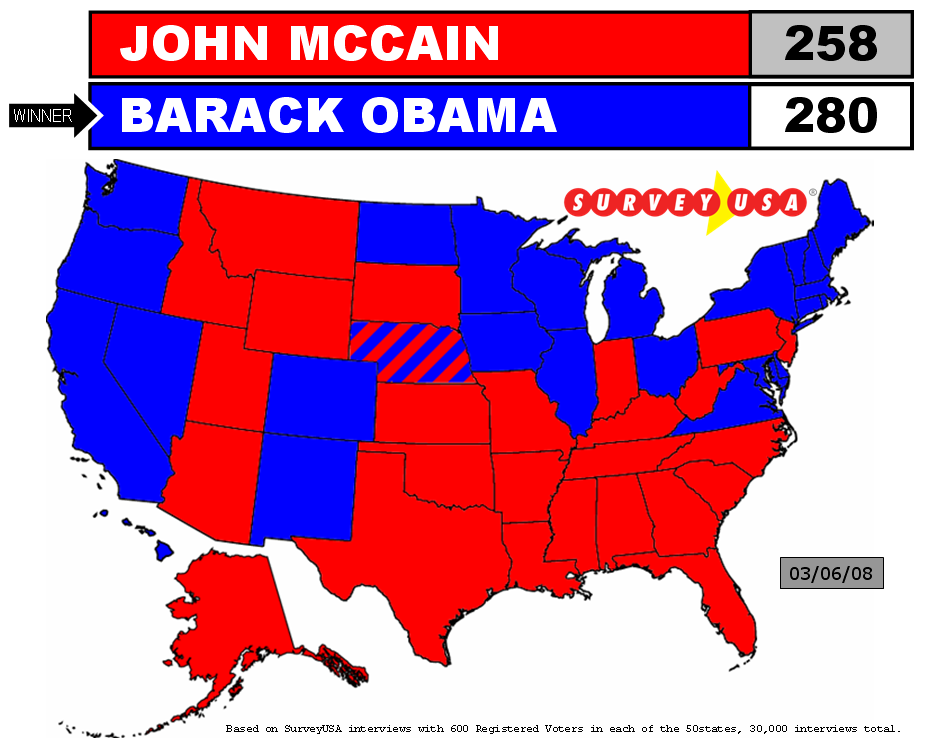
Clinton and Obama put together a very different collection of states. They get different red states in play, and they struggle in different blue states. But at the end of the day they both very narrowly beat John McCain in the electoral college vote, 280 to 258 for Obama and 276 to 262 for Clinton.

SUSA's polls confirm that, whatever the final match-up, the electoral map will not look like that of 2000 and 2004, and many states that were not that competitive in the past two contests (starting with Texas, but also Virginia, New Jersey) could be the top swing states this time around.

Before looking at numbers from the most interesting states, here are the two electoral maps, courtesy of SUSA:


As you can see, there are many differences between the two maps, and it is remarkable that both candidates come to roughly the same totals:

  • Once we weight the polls according to their state's size to get national numbers, Clinton leads 48% to McCain's 46%. McCain and Obama are tied at 46%.
  • The round-up of all 50 Clinton-McCain match-ups is here. The roundup for McCain-Obama match-ups is here.
  • States that only Clinton wins: Arkansas, Florida, New Jersey, Pennsylvania, West Virginia

  • States that only Obama wins: Oregon, Washington, Iowa, New Hampshire, Colorado, Virginia, North Dakota (!)
  • Red states that they both win: Only Ohio
It is evident from this list that Obama's strength is in the West: He comfortably keeps Oregon (+8%) and Washington (+14%) blue, two states Clinton loses (-5% and -2% respectively) and he carries New Mexico (by 7% versus 4% for Clinton). He then picks up Nevada (by 5%, while Clinton loses by 8%) and Colorado (by 9%, while Clinton loses by 6%).

All of this we are used to seeing, as Obama's edge in Western states like Washington and Colorado has been among the only consistent electability results over the past few months. But the extent of his advantage is considerable -- especially when we take into account the incredible fact that he puts the mountain states -- some of the reddest in the country -- in play! He narrowly wins North Dakota (Clinton loses by 19%), gets two out of five electoral votes in Nebraska, trailing 45% to 42% and loses South Dakota by only 4%!

But Obama is comparatively weak in the Northeast, and in many states are crucial for a Democratic victory come November: Clinton carries New Jersey by 5%, but Obama loses it in a tie at 43%. McCain continues to be competive in Massachusetts against Obama, trailing by 9% (18% against Clinton). In Pennsylvania, Clinton narrowly edges McCain by 1%, whereas the Republican beats Obama by 5%. An important exception is New Hampshire, in which Obama leads by 2% but Clinton trails by 8%.

Overall, it looks like McCain is succeeding in putting many traditionally blue states in play for his party: He is looking very strong in Pennsylvania and in New Jersey against both candidates, and he is competitive in other states in which both Democrats are leading, including places like Maryland and Delaware. Whoever the nominee is will have to move quickly to consolidate this region -- and if McCain manages to raise money quickly in the next few weeks he should try and build himself up in the Northeast before the Democratic candidate has a chance to counter-attack; it could be very damaging to Democratic chances in the fall.

But McCain is in danger in much of Red America -- or at least states that are must-wins for him. For one, he trails in Ohio by 10% against both Democrats. That's not a loss he can afford. Second, he is crushed in Florida by Hillary Clinton, 51% to 42% -- though he beats Obama 47% to 45%. It is very hard to imagine the Republican win the White House if he loses both Ohio and Florida. McCain's biggest nightmare could (unexpectedly) be... Texas! The poll shows McCain leading both Democrats by single-digits in the biggest red state of the country: He is up Obama 1% and up Clinton 8% -- and Hillary is weaker because she gets a low percentage of the black vote. Not a good sign for McCain.

There are other very worrisome numbers for McCain across the South: in South Carolina (where he is up 6% against Clinton and 3% against Obama), Tennessee (where Clinton ties him, though Obama is far) and North Carolina (he is up Obama only 2%, Clinton up 8%). In Virginia, a must-win for the Republican nominee, Obama ties him though he leads Clinton by 10%, though in West Virginia it is Clinton who conquers and Obama who stays back. In both Oklahoma and Kentucky, however, it is Clinton who gets within single digits. And if Hillary emerges as the Democratic nominee, McCain can kiss Arkansas -- her former home-state -- good-bye.

The Midwest, however, is yet another story, and McCain holds his own outside of Ohio. He survives with narrow leads in Missouri (+4% against Clinton, +6% against Obama). He holds both Democrats in single-digits in Minnesota, and he is very competitive in Michigan (he trails Obama by only 1% and ties Clinton). Michigan's 18 electoral votes flirted with Bush in 2000 and 2004 but they remained promised to the Democrat throughout those elections; this is not a state the Democratic nominee wants to have to think about.

Overall, both Democratic candidates have their weaknesses and strengths, and so does John McCain. Here is a regional summary -- and keep in mind that nearly all these lessons are confirmed by other polls we have seen recently:

  • The Big Three: Ohio and Pennsylvania have switched places, with the former appearing strongly Democratic and the latter a complete toss-up. Exchanging them does not do Democrats much good, and Florida seems as always all over the place -- with Clinton posting a strong lead and Obama trailing.
  • West: This is where Obama has his greatest potential to put McCain on the defensive in many red states (starting with NV and CO), while this is by far Clinton's weakest region (and she seems consistently unpopular in places like OR and WA) .
  • Northeast: Obama's most vulnerable region is also the one in which McCain appears to have the mots potential, as independents in many of these must-win blue states appear ready to flirt with the Arizona Senator (particularly New Jersey).
  • South: Between each other, the two Democrats put most of the states of this region within single-digits, testifying to McCain's weakness in red America.
  • Midwest: This region looks ready to be the nation's tightest area once again, with Missouri, Minnesota, Wisconsin and Michigan (and, of course, Ohio) all posting very competitive races.

Labels: , , ,

2.27.2008

Wednesday polls: General election toss-ups

Four general election surveys were released today, with very little consistency in the issue of the electability gap between the Democrats, but all showing John McCain in a strong position -- much stronger than his former GOP rivals appeared to be a few weeks ago:
Wednesday
  • First, Quinnipiac released a general election survey which shows both Democrats barely edging out the Arizona Senator -- 44-42 for Clinton and 42-40 for Obama -- in a state either will have to win come November.
  • This poll is very interesting because it underscored just how different the two candidates' core constituencies are. Among Democrats, Clinton gets 80% and Obama only 69%! Among independents, Clinton trails by 2% and Obama leads by 5%. Both Obama and Clinton are weak in one of those groups and they will have to be strong if they want to build a solid majority.

  • In Ohio, a University of Cincinnati survey shows Obama edging out McCain 48% to 47% and McCain leading Clinton 51% to 47%. SUSA's recent poll from Ohio has shown Democrats in a slightly stronger position.

  • Next, a poll from Tennessee gives a clear edge to John McCain who crushes Obama 53% to 37%. Clinton runs much better than Obama here and makes the race competitive: 45% to 41%. Until recently, Clinton used to systematically run ahead of her Democratic rival in Southern states.
  • In North Carolina, finally, a new poll shows McCain in a strong position, crushing both Democrats by double-digits, 48% to 36% against Hillary and 46% to 36% against Obama. PPP released a poll from NC a week ago that showed the Republican ahead by 5% against both Democrats.
No earth-shattering numbers here. The question this early in the campaign is in what states will the general election campaign really engage in, what states look competitive with a McCain candidacy? These numbers from NC and TN -- the kind of states in which some of the Republican candidates looked particularly weak -- should offer the GOP some comfort that they won't have to put just as much defense here, though there is little doubt that the map will be significantly more expanded than it was in 2004 and that we should get used to the fact that many states that were on no one's radar screen then will host some very competitive races this year.

Labels: , , ,

2.22.2008

SUSA releases wave of competitive general election polls

SUSA released 8 general election polls today, getting it to a total of twelve within 3 days. First, they had shown Iowa and Virginia to be competitive, with Obama looking strong in the former and competitive in the latter, and Clinton struggling in both. In Kansas and New York, SUSA also found Obama running stronger than Clinton (surprisingly in New York), with McCain trailing both candidates in NY and leading them in KS.

Today's wave of polls offers a more complex picture of competitiveness and electability, with McCain competitive in unlikely places (Massachusetts, particularly against Obama for the second poll in a row) and struggling in others, and with Clinton pulling in stronger numbers than her rival more than we have been used to in recent weeks.

As you will see while going through these numbers, both Clinton and Obama have very clear groups among which they are stronger: Clinton outperforms Obama among women and Democrats; Obama among men, blacks and independents. And while one might think that it is more important for the nominee to appeal to independents than to Democrats, to whites than to black in order to win the swing states, that cannot get the Democratic Party very far: The base needs to be secured (and motivated). In Ohio, for example, Obama is stronger than Clinton among independents; but he is so much weaker among registered Dems than Clinton outperforms overall. The same is true in reverse for Clinton's relative weakness among black voters.

Democratic and African-American votes are usually taken for granted by the party's nominee, but it should not just be assumed that Obama and Clinton will post strong numbers come November. After all, John McCain's main asset is that he appeals to Democrats, after all; and while black voters are unlikely to go to McCain they could choose to not turn out, which could prove a very big problem. In other words, either Obama and Clinton would have a lot of work to do to secure the Democratic base, and McCain is well positioned to take advantage of their weaknesses.

And with that, let's look at the numbers:

  • In Ohio, Clinton leads McCain 52% to 42%, while Obama is up 47% to 44%. The difference comes entirely from registered Democrats, which go 85-10 for Clinton but only 71-21 for Obama. Among independents, in fact, Obama is stronger even here, leading 50% to 36% versus 48% to 40% for Clinton.

  • In Missouri, both Democrats are ahead: 51% to 44% for Clinton, 49% to 43% for Obama.

  • In New Mexico, Clinton leads 50% to 45% and Obama does much better, 55% to 40%. This is due both to the male vote (Clinton is tied, Obama leads by 15) and to independents (Obama leads by 5, Clinton trails by 12).

  • The numbers are almost the same in Minnesota, where Clinton leads 49% to 45% but Obama crushes McCain 55% to 40%. Obama runs 20% better among men, and he also does much better among independents.

  • Oregon is another state in which Obama runs stronger, edging out McCain 48% to 47% while Clinton trails 49% to 41%. This is entirely due to the independent vote, which Obama wins 52% to 41% and Clinton trails 54% to 33%.

  • The most surprising numbers come perhaps from Massachusetts, one of the country's bluest state in which McCain is very competitive, trailing 52% to 43% against Clinton and only 48% to 46% against Obama. In the last SUSA poll, McCain actually had a small lead against Obama, whose weakness is due to the female vote (+11 instead of +32 for Clinton).
  • In California, neither Democrat has any trouble dismissing McCain: 58% to 35% for Hillary, 61% to 34% for Obama. The gender difference is astonishing: Clinton gets +39 among women and +6 among men; Obama gets +25 among men and +9 among women.
  • Finally, in Alabama, McCain easily beats both Clinton (57% to 37%) and Obama (58% to 34%). Obama performs much better among blacks (87% against 69% for Clinton) but much weaker among whites (17% versus 26% for Clinton), in one of the only instances of such a racial divide.
Other than Massachusetts, there are no huge surprises in this group of polls, and we can expect the states we are used to thinking as tight to remain so in the coming months, including Ohio. If anything, the Democrats should be really happy about Missouri, a fairly large state in which they have been consistently competitive and which looks ripe for pick-up. The Democratic nominee can certainly hope to reach a majority by winning not a big Bush state like Florida and Ohio but putting together smaller ones, with Missouri and Virginia the obvious suspects at this point (as well as IA and NM, of course, but it is hard to think of those as red).

Labels: , , , , , , ,

2.20.2008

Scrutiny increases, in preview of general election

A major development of the past 24 hours has been that Obama and McCain are setting their sights on each now, as McCain seeks to weaken his most likely general election opponent and Obama is responding, eager to emerge as his party's spokesperson. (Some commentators are saying that McCain is trying to weaken Obama to help Clinton win the nomination, but that does not seem to be a very compelling explanation given that the entire GOP field was obsessed with Hillary as of a month ago.)

And with that, Rasmussen released two general election polls this morning from two swing states where the election looks tight:

  • In Ohio, Rasmussen shows McCain edging out both Democrats within the margin of error, 42% to 41% against Obama, 46% to 43% against Clinton.
  • In Michigan, Obama runs stronger than Clinton, leading McCain 47% to 39% while Clinton ties the Arizona Senator at 44%.
My last discussion of general election polls (here) still holds with these surveys, so I will delve straight into the increased scrutiny that Obama and McCain are now receiving.

Obama's fighting power tested: This comes out of Michelle Obama's statement at a recent rally that “For the first time in my adult life, I am really proud of my country." I was not planning on addressing this issue at all, but the controversy is now taking such proportions -- and serving as a preview of the general election -- that it is becoming hard to ignore it entirely.

Conservative blogs and outlets such as Fox News quickly seized on this issue, happy to further their preferred storyline that Democrats are part of the "America last" crowd. To make sure that the quote hit the mainstream media, the GOP turned to Cindy McCain, who very rarely makes such partisan comments but who declared yesterday, "I am proud of my country. I don’t know about you. If you heard those words earlier, I am very proud of my country." John McCain made his own pointed reference at Michelle's comments in his Wisconsin victory speech. And since then, Bill O'Reilly has gotten in trouble for his own attack:

I don't want to go on a lynching party against Michelle Obama unless there's evidence, hard facts, that say this is how the woman really feels. If that's how she really feels — that America is a bad country or a flawed nation, whatever — then that's legit.

Michelle Obama's has since explained that she meant that she was never proud of the country's politics, and this is the first time she thinks the US is ready to move beyond politics as usual. And the firestorm that her initial comment is causing looks to be as fabricated as the ones that the Right forced upon Teresa Heinz Kerry. Obama is still mostly undefined in the country, and the Republicans want to move fast to portray the Illinois Senator as an out of the mainstream candidate, just as they did with John Kerry in 2004.

In essence, this controversy is serving as a test of the Obama campaign's ability to fight back against Republicans. This, of course, is one of the main arguments the Clinton campaign has against him. Hillary always says that she has fought the GOP machine for years, and that Obama is not prepared for what the Republicans will do to him in the coming months. What she is basically saying is that she will not let herself be swift-boated the way Kerry was, and that she will hit back.

Now, Obama is facing that type of tactic, but his campaign took a long time to offer any kind of defense or response. They let the controversy grow without addressing it, which is exactly what allowed the Swift Boat ads to become so influential in 2004. And this also serves as a warning to Michelle Obama, who Republicans will now seek to transform into a controversial figure. Given how successful they were with that in 2004, the McCain campaign will no doubt go at it again, and Democrats are now warned.

McCain hit by the New York Times: The NYT has just published a story today that they had been mostly written since December. There was news then that the Times had a major story under wraps and that they were not releasing it, prompting McCain to try fighting back preemptively. The article is now up and is a must-read given how much it will likely be discussed in the coming days. It focuses on McCain's ethics, and explains why the Senator is not always as clean as we would like to think he is -- starting with the Keating Five scandal towards which a large portion of the piece is devoted. The article implies that much of McCain's subsequent focus on ethics has been to repair his reputation hurt by Keating, and that this quest is not without its ambiguities: "Even as he has vowed to hold himself to the highest ethical standards, his confidence in his own integrity has sometimes seemed to blind him to potentially embarrassing conflicts of interest."

But the most important parts of the article (and those that are new) are devoted to McCain's relationship with a lobbyist, Vicky Iseman. On the one hand the implication is that there are doubts the two had a romantic relationship; on the other that McCain might have done some ethically improper favors:

A female lobbyist had been turning up with him at fund-raisers, visiting his offices and accompanying him on a client’s corporate jet. Convinced the relationship had become romantic, some of his top advisers intervened to protect the candidate from himself — instructing staff members to block the woman’s access, privately warning her away and repeatedly confronting him, several people involved in the campaign said on the condition of anonymity.

And later still:

Separately, a top McCain aide met with Ms. Iseman at Union Station in Washington to ask her to stay away from the senator. John Weaver, a former top strategist and now an informal campaign adviser, said in an e-mail message that he arranged the meeting after “a discussion among the campaign leadership” about her.

“Our political messaging during that time period centered around taking on the special interests and placing the nation’s interests before either personal or special interest,” Mr. Weaver continued. “Ms. Iseman’s involvement in the campaign, it was felt by us, could undermine that effort.”

There will be a lot of discussion in coming days as to how damaging these allegations are, but what has got to be worrisome for McCain is that they struck at the core of his appeal: the fact that he is a different kind of politician, clean on ethics. And one problem McCain might face is that there is a preexisting narrative that such articles can tap into that supports a narrative of a more unethical McCain -- and that is exactly the narrative the NYT is here referring to by grounding its story in the Keating Five.

Another thing to consider is that the NYT article appears to have been edited quite extensively, and a lot of things seem to have been cut out. There are allusions to more details existing, particularly about possible favor, so this story could drag on if these details emerge later.

Labels: ,

2.14.2008

As eyes turn to upcoming contests, Clinton looks like she could rebound

Facing the prospect of losing two more contests next Tuesday when Wisconsin and Hawaii go to the polls, Hillary Clinton appears to have decided to make an effort in Wisconsin. She installed Teresa Vilmain, who ran her Iowa campaign, to organize Wisconsin and she is planning on spending four days in Wisconsin starting on Saturday.

It is unclear whether the campaign thinks it can win in Wisconsin, but they have clearly realized that they cannot afford another 20+ loss, both because of the momentum it would give Obama in a two-week period with no elections and because the delegate lead would just keep widening. Polls suggest that Obama is narrowly ahead, but that Clinton is poised to keep this one close:

  • A new Rasmussen poll released this morning shows Obama leading 47% to 43%, up 23% among men and trailing 10% among women.
Balancing things in Wisconsin could allow Clinton to stay afloat in the final two weeks leading up to March 4th (and its two debates), and preserve her lead going into Ohio. The one public poll of the race for now suggested that she had a 17% lead, and two new surveys out this morning confirm the size of Clinton's lead right now:

  • Rasmussen has Clinton up 14%, 51% to 37%, boosted by a large lead among women.
  • Quinnipiac is even more favorable to Hillary, showing her to be ahead 55% to 21%. Obama is trailing by 26% among white men here, a constituency that has been looking better for him in other states.
The Quinnipiac poll was taken over the course of 6 days post-Super Tuesday, so it does not really incorporate the shifts that might have happened after Obama's latest string of victories, but Rasmussen's was in the field last night. Quinnipiac also released a poll from the Pennsylvania primary, which could prove decisive if Clinton survives March 4th. For now, she has an edge in PA too, leading 52% to 36%. Worth noting that both polls show huge educational gaps and racial gaps.

The challenge Clinton faces is that she cannot just narrowly win the three big contests that are coming up (OH, PA and TX), she needs to do so decisively to cut into Obama's delegate lead. She has not gotten that kind of margin anywhere but New York and Arkansas and, to some degree, in California, where her unexpectedly strong showing gave her an edge of more than 40 delegates. The good news for Hillary is that the events of the past few months have not made her fall in Ohio yet. A 14%+ victory there, if she can also pull off Texas, would surely give her enough momentum to continue and make a renewed case for Florida and Michigan.

  • General election
In conjunction with the primary polls I just mentionned, Quinnipiac also released general election polls in PA, OH and FL, three of the hottest swing states of 2008. All three states are close, confirming that they will once again decide this year's contest, and there is no clear electability difference between Obama and Clinton. If anything, she runs narrowly better than him, especially in Pennsylvania:

  • Against Clinton, McCain leads 44% to 42% in Florida, 44% to 43% in Ohio. He trails 46% to 40% in Pennsylvania.
  • Against Obama, McCain leads 41% to 39% in Florida, 42% to 40% in Ohio and trails 42% to 41% in Pennsylvania.
In all three of these states, Clinton runs significantly better than Obama among registered Democrats -- 15% better in Pennsylvania. And that is not a weakness Obama can necessarily rectify easily as time goes by, as McCain has shown capacity in appealing to moderate Democrats, a group that is not crossing-over if Clinton is their nominee. On the other hand, Obama runs stronger than she does among independents, and their respective weaknesses among indies and Dems offset each other. Now, McCain appeals to both of these groups. Clinton and Obama both defend one turf very well and are weak among the other. It is hard to imagine either doing well without the other group...

Labels: , , , , ,