6.19.2008

Thursday polls: McCain leads big in Florida, Udall opens a lead in CO

The pace of polls certainly looks to have picked up after a big wave of surveys yesterday brought good news to Obama's campaign yesterday. Today's polls serve as a reminder that the presidential race remains close:

  • Fox News's national poll finds Barack Obama leading John McCain by a narrow 45% to 41%. In a four-way race, Obama's lead is 42% to 39% with 4% for Ralph Nader and 2% for Bob Barr.
  • Fox News included questions about which candidate "loves America" the most. These questions are silly enough that I see no need to include the results.
  • In Florida, Rasmussen found John McCain leading 47% to 39%. This is a slight improvement from McCain's 50% to 40% lead last month.
  • Obama's favorability is negative (46% to 48%) and 33% have a very negative impression of him, versus 21% for McCain (the Republican's overall rating is 50% to 46%).
  • Asked whether they think offshore drilling would lower oil prices, 61% of Floridians responded in the affirmative.
  • Finally, Colorado is a toss-up in the latest Rasmussen poll, as Obama leads 43% to 41% -- down from a 48% to 42% lead last month.
  • Here again Obama has a high very unfavorable rating (31%, against 18% for Obama) and his favorability rating has dropped to 50%.
Colorado is one of Obama's top targets and the fact that he has not trailed once in Rasmussen's 5 polls from the state confirms that he ought to target Colorado's 9 electoral votes. But after yesterday's two Florida surveys showing Obama leading by 4% and 5%, Rasmussen's poll is a reminder that, as long as the election remains tight, we will be seeing a lot of inconsistency in these big swing-states. While yesterday's polls should reassure Democrats that McCain has not locked Florida in his column and that this contest will remain competitive, Obama retains a number of disadvantages in the Sunshine state, which has been trending Republican over the past eight years and which resisted to the Democratic tsunami better than other states back in 2006.

These presidential surveys were accompanied by a fair number of congressional polls:

  • In Colorado, Rasmussen finds Mark Udall extending his lead over Bob Schaffer. He is now leading 49% to 40%.
  • In Kentucky, the McConnell campaign released an internal poll showing the incumbent with a 50% to 39% lead against "Democrat" Bruce Lunsford.
  • In one of the most hotly disputed Dem-held House seats, incumbent Nancy Boyda released an internal poll conducted by Anzalone Lizst that finds Boyda crushing her two potential opponents, 54% to 37% against former Rep. Jim Ryun and 57% to 27% against state Treasurer Lynn Jenkins. It goes without saying that you should take this poll (and any internal poll) with a huge grain of salt.
  • The poll also finds McCain beating Obama by 7% in a district Bush carried by 20%.
  • Finally, SUSA released two congressional polls from Washington State. In competitive WA-08, Rep. Dave Reichert is holding off on his Democratic challenger Darcy Burner 51% to 45%. This is a rematch of a 2006 race which Reichert won 51% to 49%.
  • In WA-02, a district Kerry won by only 4%, Rep. Larsen leads 56% to 38%, confirming that the Democrat is safe in this district the GOP could hope to contest in better conditions.
In Colorado's open gubernatorial race in 2006, Democrat Ritter unexpectedly opened an early lead against his highly-touted Republican opponent and never looked back, easily carrying the election in November after a campaign that was never truly competitive. This was certainly a reflection of how toxic the environment was for the GOP. The same exact pattern held in Minnesota's open Senate race, and Democrats were expecting Mark Udall to enjoy similar success this year. But the race has remained very tight, giving Republicans hope that all is not lost. It is only in the past two months that Udall has opened up a somewhat consistent lead, boosted by the bad press Schaffer has gotten over corruption issues and even ads he ran. Keep an eye on polls over the summer: If Udall maintains a lead, we might be in for a repeat of the CO and MN races from 2006 and the NRSC would probably abandon Schaffer to his fate.

As for Kentucky, this is the second time that McConnell is releasing an internal poll immediately after an independent survey found a competitive race. The first was in late May after Rasmussen found Lunsford leading him by 5%. This one is a response to a SUSA survey released earlier this week with McConnell up 4%. Both of McConnell's internal polls have found the same result -- 50% to 39% -- and it is telling that this is being spun as reassuring numbers by the incumbent. For the Senate Minority Leader to be hovering on the vulnerability threshold of 50% is certainly cause for worry and should encourage the DSCC to look closely in Kentucky's direction.

Labels: , , , , , ,

6.18.2008

A few more late afternoon polls: Obama leads in his second FL poll, but OH is tied

After weeks of not getting a single poll from OH and FL, here is the third Ohio poll in two days -- and a reminder of how much indecision we should expect in polls as long as the race remains a toss-up:

  • Unlike PPP's 11% lead yesterday and Quinnipiac's 6% lead earlier today, Obama is slightly behind in Rasmussen's new poll, though well within the MoE: McCain gets 44% to his 43%, the same margin as the May poll. Obama gets 53% favorability rating against a high 47% (including 31% very unfavorable).
Unless (or until) the election becomes a blowout, it is unlikely that Ohio will ever clearly belong in one or the other camp. This is just a reminder that the election at this point in time remains tight in most of the states that will matter. Meanwhile, ARG released a general election poll from Florida that finds a similar result as Quinnipiac's:

  • Obama is leading 49% to 44%. Both candidates get under 80% from their own party.
  • In case of an Obama/Nelson-McCain/Crist match-up, the GOP ticket is ahead 43% to 42%.
Earlier today, the Quinnipiac survey was the first ever to find Obama leading McCain in the Sunshine state, meaning that the only surveys finding a Democratic advantage were released today. The GOP still has a slight edge in Florida -- Obama is under-organized here and this is a state that resisted the Democratic tsunami fairly well in 2006 -- but the fact that the Illinois Senator looks stronger than expected is a bad sign for McCain's hopes of putting this one away.

Also this evening, ARG released a survey from New Hampshire, another rarely polled state:

  • Obama leads 51% to 39%, including a 15% lead among independents.
  • In the Senate race, Jeanne Shaheen leads Senator Sununu 54% to 40%.
  • And no surprises in the gubernatorial race, as Governor Lynch crushes his minor opposition 65% to 21%.
It is difficult to know what to make of New Hampshire, a state that both candidates have reason to believe they can do well in. The state's large independent contingent swung dramatically towards the Democrats in 2006, a pattern that should at least somewhat hold this year. But New Hampshire has long been kind to McCain, saving him from the dead in 2008 and grant him an unlikely blowout victory against George Bush in 2000.

McCain won both of these contests based on his strength with independents and he hopes to win them over against Obama -- just as he did in on January 8th. Remember that more than expected independent voters chose to participate in the GOP primary instead of the Democratic one, allowing Clinton to upset Obama and McCain to distance Romney. But ARG's poll suggests that McCain's long relationship with New Hampshire and its independents could snap this year. This is one of the two Kerry states that Republicans believe they can pick-up the most (along with Michigan) and putting it away early would be great news for Obama.

Labels: , , , ,

Wednesday polls: Strong day for Obama who leads big in PA, OH, WI and ME and within the margin of error in VA and FL

Quinnipiac released its eagerly anticipated set of swing state polls, and after two weak showing by Obama in the waves of early April and mid-May, he has improved significantly over the past month by solidifying the support of registered Democrats. Though his lead in all three of these states is inferior to where Clinton stood last month, it still represents a significant shift towards the Illinois Senator:

  • In Florida, Obama is ahead 47% to 43%. He trailed by 4% in May.
  • A month ago, he trailed among independents and got 71% of the Democratic vote. In June, he leads indies by 10% and has the support of 82% of Democrats. 19% of those who voted Clinton in the primary would choose McCain, however.
  • In Ohio, Obama leads 48% to 42% -- no doubt boosted by Bush's dismal approval rating of 22%! He trailed by 4% in May.
  • He has improved his share of the registered Dem vote from 69% to 80% and trails by 3% among independents. Among Clinton voters, however, he only leads 63% to 25%.
  • In Pennsylvania, finally, Obama crushes McCain 52% to 40%. He led by 6% in May.
  • Obama gets 78% of registered Democrats compared to 71% in May. He leads by 11% among independents, though his support among Clinton voters remains tepid (66% versus 24% for McCain).
This seems to be the first Florida poll to ever find Obama ahead of McCain, too early, then, to know whether something is actually changing (this is also the first Florida poll released by any institute since Quinnipiac's last poll a month ago!). But note the uniformity of the bounce in Obama's favor: He has improved by 6%, 6% and 8% in these three states, suggesting about the same size bounce that we witnessed in Rasmussen and Gallup's tracking. The margin has narrowed again in those trackings and that we will have to wait for confirmation that Obama has jumped up in those states from other surveys (PPP yesterday showed Obama up 11% in Ohio). Also, black support in favor of Obama is particularly strong and is what is helping the Democrat create some space: He gets between 90% and 95% of the African-American vote, much stronger than what Kerry got in 2004.

As Quinnipiac points out, no candidate has won the election without at least two of these three states in 48 years, so for Obama to get even two would make the road to the White House very difficult for McCain. However, Michigan now appears to be just as competitive as these 3 states and muddies the equation a bit, as picking up Michigan could help McCain offset the loss of Ohio. Meanwhile, a number of other polls were released today from other crucial states that Obama seems intent on contesting:

  • First, Zogby's latest national poll shows the Democrat leading 47% to 42%. Other good news for Obama: he leads by 22% among independents. The bad news: He is only ahead 54% to 44% among Hispanics and 54% of respondents say he does not have the experience to be president.
  • In Virginia, PPP finds Obama edging out McCain 47% to 45%. He gets 78% of Democrats -- a strong showing in a Southern state.
  • In Wisconsin, SUSA finds Obama ahead 52% to 43% -- up from a 6% lead in May. This includes the support of 91% of registered Democrats (!) and a 23% lead among women.
  • SUSA also continues to provide completely useless VP pairings: Which poll respondents has ever heard of Carly Fiorina?
  • In Maine, Obama crushes McCain 55% to 33%, up from a 13% lead last month in a new Rasmussen poll. There's no breakdown by congressional district but with this sort of lead there is no doubt Obama is ahead in both.
  • In Alaska, finally, Rasmussen continues to find competitive races, with McCain ahead 45% to 41%, down from a 9% lead last month.
  • McCain and Obama have comparable favorability ratings (58% to 53% rspectively) but the enthusiasm level really varies, both among very favorable opinions (29% Obama and 18% McCain) and very unfavorable (31% Obama). This is a pattern we are seeing in many red states.
Wisconsin's lead confirms other polls we have been seeing and my hypothesis that the "Dukakis 5" states are coming home, slowly removing 5 blue states from the list McCain can contest. The Alaska poll is stunning, of course, though it is unclear how much the campaigns will look in that direction (it is rather far, after all).

And I have resolved to no longer express wonder and amazement when a Virginia poll shows a tie or Obama narrowly ahead, as every poll recently released from the Commonwealth shows that result -- including one released early this week. That the state's 13 electoral votes are in play are a nightmare for McCain as they expand the map in a region the GOP has long not had to defend. With Mark Warner set to destroy Jim Gilmore, there could even be reverse coattails -- as the PPP poll confirms:

  • This Senate race is no doubt polled so much because Virginia is competitive at the presidential level, but we are still waiting for Colorado to be polled this much. PPP finds Warner crushing 59% to 28% and the worst news for Gilmore is that no one is surprised...
  • In more interesting Senate news, Susan Collins continues to slip in Maine. The latest Rasmussen poll finds her ahead 49% to 42% -- under 50% and within single-digits for the first time. Last month's poll, finding her ahead by 10%, was already the tightest the race has ever been.
  • Proving that Collins is in a Chaffee-esque situation of being driven down by her party rather than by her own liabilities, she has a shockingly high 70% favorability rating.
  • In North Carolina, Elizabeth Dole rebounds in a new Civitas poll: Barely ahead 45% to 43% last month, she is now leading 48% to 38%.
  • In another congressional poll from that state, this one from NC-08, Larry Kissell is narrowly ahead of Rep. Hayes 45% to 43% in an internal poll conducted by Anzalone Liszt.
  • This is a district that voted Bush twice (including by 9% in 2004) but Obama leads McCain 50% to 37% (should we take that as a sign that the poll oversamples dems? A 23% swing from where we were 4 years ago is perhaps a bit much).
Maine has long been a disappointment to Dems, as Collins has been ahead by more than 20% in many polls taken since the fall of 2007. But as partisan passions heat up in the coming months it looks like Collins could get dangerously close to being this cycle's Linc Chaffee and suffer from her party's dismal ratings. As Al Franken's situation is worsening in MN, the DSCC would be delighted to get Maine back in the picture. As for NC, Dole is still under 50% in the Civitas poll but this is the second pollster (after Rasmussen) among those that had shown a tied race in May (after Hagan's primary victory) to find that Dole has rebounded. There are clear reasons for that, too: (1) Hagan's primary bounce faded and (2) Dole has been running TV ads over the past few weeks. Still within striking distance for Democrats but no reason to be as euphoric as the DSCC was last month.

Labels: , , , , , , , , , ,

5.22.2008

Electoral maps: Quinnipiac's "big state" polls find trouble for Obama in FL and OH, SUSA shows him strong in VA

It is hard to deny that general election polls are consistently showing Barack Obama to be weak in Ohio and Florida. The latest Rasmussen polls from those states, which both showed Clinton running significantly better than Obama, led me to consider the implications for Obama's electoral map, and the choice his campaign will likely make to privilege states that they believe will be more receptive to Obama's message.

Today, the latest wave of "big state" polls from Quinnipiac confirms that Clinton's electoral map would have centered on Ohio and Florida in a way that Obama's map will not:

  • In Ohio, Quinnipiac finds that Clinton beats McCain 48% to 41%; Obama trails 44% to 40%. McCain has improved his margin by 3% against both Democrats.
  • Clinton gets 85% of the vote of registered Democrats, Obama only gets 69%. He also trails by a wider margin among independents and does 17% worse among working-class whites.
  • In Florida, Clinton leads 48% to 41% also while Obama trails 45% to 41%.
  • Clinton wins 86% of the registered Democrats vote, while Obama only gets 71%. Obama also trails by a wider margin among independents. In a key measure, Clinton loses the working-class white vote by 2%, Obama by 20%.
  • 43% of Floridians say Obama's association with Wright makes them less likely to vote for him... the same number that says McCain's association with Bush makes them less likely to vote for the Republican nominee!
  • In Pennsylvania, Clinton leads McCain 50% to 37% while Obama is ahead 46% to 40%. McCain has improved his numbers by 1% and 3% respectively.
  • Clinton gets 86% of the registered Democratic vote, while Obama gets 73%. This is one state in which Clinton looks much weaker among African-Americans, as she gets only 78% of the black vote as opposed to 94% for Obama.
These polls might be used by the Clinton campaign to bolster their electability case to superdelegates. But there is no reason to believe that superdelegates will be affected: We have known for a long time that Obama and Clinton's electoral maps would take different forms, and that Ohio and Florida would be more important for the Clinton campaign. Furthermore, with the competitive part of the Democratic primary over, these polls are certainly more important for what they tell us about the coming general election.

In short, I would like to frame the conversation in terms of electoral maps rather than electability.

A problematic area for Democrats is that both candidates lose the independent vote in Ohio and in Florida. Independents massively turned to the Democratic Party in 2006 and it is that choice that allowed the party to make gains in the midterms. When asked to rate Bush's performance or in down-the-ballot polls, independents are still behaving as Democrats. But McCain is able to stop his party's bleeding and hold on to a lead in two of the major swing states against either Clinton or Obama.

For Obama, these numbers are one more reminder that he cannot take the vote of registered Democrats for granted. Some argue that these are just disaffected Clinton supporters who will easily return home once the nominee is chosen. There is no doubt that some of them will, and that Obama certainly has the capability of capturing the support of most Democrats who are reluctant to support him. But it would be a grave mistake to assume that registered Democrats will back the party's nominee no matter what. They have left the party in the past, and the appeal to (1) conservative Democrats and (2) Hispanics lies at the heart of McCain's electability.

The Obama campaign will have to spend a significant amount of time and resources solidifying the Democrats' blue-collar base and Hispanic supporters, especially if he wants to keep Ohio and Florida competitive. The good news is that a secure and unified base might be enough to win this election: More voters are identifying themselves as Democrats than they have in a long time, and if Obama is trailing by only 4% with weak showings among registered Democrats it does suggest that the answer lies with Democrats rather than at the center or in attracting Republicans.

And just in time to confirm that Obama's campaign is looking to emphasize other states and construct a different electoral map, SUSA released a poll from Virginia:

  • In this red state, Obama leads McCain 49% to 41%, including a 66% to 27% lead in Northern Virginia.
  • This is a poll testing VP choices, so Clinton is not included and you can check all the VP choices here. As always, the best Democrat by far is John Edwards as he bolsters Obama's numbers among registered Democrats, but that is also a name recognition factor.
Some Democrats worry that replacing OH and FL by states like VA and CO might be risky considering that these states have not been kind to Democrats in presidential elections in the past. But polls like SUSA's confirm that Obama does have an opening in those states (a poll yesterday showed Obama trailing by 8% in VA, but the numbers looked weird considering how weak the Democrat was in NoVa). You can be sure that this is a debate that will be waged for the coming weeks, as the Obama campaign tries to settle on a general election strategy. But whatever map they choose to go with they will have to move to secure the Democratic base -- perhaps not with John Edwards's inclusion on the ticket, but some strategy will have to be devised.

Labels: , , ,

5.01.2008

Obama suffers from worrisome wave of polls

In the first days of the initial Wright controversy back in mid-March, Barack Obama suffered a terrible polling day in which he plunged in a series of 9 catastrophic polls. While today's polls are not quite as traumatizing, Obama is consistently found to be losing ground both against Hillary Clinton and against John McCain, suggesting once again that Obama's support declines the more Wright is in the news. Whether Obama's Tuesday press conference ends up helping him, of course, will be determined in the coming days. But with a Clinton campaign ready to exploit any sign that Obama has an electability problem, numbers like these (and from respected pollsters like Quinnipiac) will not make Obama's already difficult week any less painful.

First, on to the primary polls from the two May 6th states:

  • Rasmussen's tracking poll shows Clinton taking a narrow 46% to 44% lead, a 10% swing in the past two days and the first time she is ahead since April 13th.
  • Gallup's tracking today also finds Clinton gaining ground, now leading Obama 49% to 45%, the first time she is ahead by more than 1% in quite a while. In the general, Clinton now runs 4% better than Obama as she is tied while he trails by 4%.
  • In what is the best polling news for Obama today, the race in Indiana remains close, with Clinton up 46% to 41% according to Rasmussen's poll conducted on Tuesday night. Clinton only gets 4% (!) of the black vote (she can explain a bit more on Tuesday) and leads among whites by 19%.
  • Update: A second poll from Indiana released this afternoon by IN-based TeleRsearch has Clinton leading by 10%, 48% to 38%. She also improved her number as the days passed, in another confirmation that the week-end was rough on Obama.
  • Now comes the North Carolina shocker: Insider Advantage finds Clinton ahead, 44% to 42%! Clinton was merely trying to keep the race competitive -- read single-digit -- and now a poll has her leading. That's a 17% swing in Clinton's favor since the last IA poll.
  • Now, keep in mind that the internals suggest that the picture is not as rosy as this for Clinton: Obama only gets 65% of the black vote, which is also somewhat underrepresented; accounting for that, Obama would undoubtedly in the lead. But the trendline among white voters is also very significant, as Clinton has increased her margin by 14%, so a large part of the 17% swing is due to this shift.
  • Mason-Dixon releases its own poll from North Carolina, finding Obama ahead 49% to 42%; this survey is more in line with previous polls and it confirms that Clinton has managed to push the race down to single-digits. A few days ago, a loss by 20% or more looked quite possible.
As long as Clinton wins in Indiana, she would be able to use a narrow loss in North Carolina to her advantage, for such a result would be one of the most (only?) unexpected results of the past few weeks, in a primary season in which both candidates have struggled to break each other's serve. But Clinton might regret these polls if they shift expectations in the next few days; there are enough days until Tuesday's primary for the media narrative to change away from NC being an expected blowout for Obama to "will he break double-digits?" This is, of course, exactly what happened in Ohio and Pennsylvania.

Meanwhile, a series of general election polls also paints a troubling picture for Obama who has lost his edge relative to McCain in four polls taken in crucial swing states:

  • Rasmussen polls New Hampshire and finds McCain leading against both Democrats. But , while this is a state in which Obama usually far outpaces Clinton, he loses by 10% (51-41) while Clinton trails 47% to 44%. Last month, Obama trailed by 3%; two months ago, he led by 13%.
Quinnipiac released its monthly wave of polls from the "Three Big States" (FL, OH and PA):

  • In Florida, Clinton beats McCain convincingly, 49% to 41%. Obama trails 44% to 43%. This is an improvement for both Democrats; last month, Clinton only led by 2% but Obama was crushed by 9%.
  • In Ohio, Clinton reaches double-digits against McCain, 48% to 38%, while McCain narrowly edges out Obama, 43% to 42%.
  • In Pennsylvania, however, the prolonged exposure both Democrats got appears to have helped their cause. Clinton crushes McCain 51% to 37%; Obama gets a large lead as well, 47% to 38%.
  • The big difference comes among white working-class voters: Clinton is tied in FL, leads by 6% in OH and by 8% in PA among this group of voters. Among this same group, however, Obama trails by 17%, 15% and 7%! That's quite a large differential with Clinton.
  • Obama also suffers from his usual problem among registered Democrats; in Florida and Ohio, he only gets 69%. His edge relative to Clinton among independents is not as large as usual.
If I was looking at these numbers exclusively from the point of view from the general election, they could certainly be spun in a very different light: After a very difficult month, bitter-gate and Wright (the second wave of Wright is not included in these polls), Obama is tied with McCain in OH and FL and he has opened up a large lead in Pennsylvania, most probably thanks to the millions he spent on PA television in the run-up to the primary. Combined with Clinton's showing, the PA results are very good news for Democrats; the Keystone state is one of the most important swings states that they cannot afford to lose. Kerry and Gore spent a lot of time and money there, and it would be a huge boost if the Dem nominee did not have to do the same this year. The fact that McCain is not able to benefit from McCain's troubles suggest that Republicans might have a very difficult time finding competitive numbers for a while after the Democratic primary is over.

Viewed through the primary lens, of course, the NH and Quinnipiac polls are the ideal set of results Clinton would have designed herself: She has somewhat managed to open a large lead against McCain in all three states (it is very difficult to imagine a Democrat losing despite winning all three of these states), and her electability advantage comes from Obama's weakness among working-class whites, the group among which Obama is consistently weak. (Predictably, Kos's latest post hits Clinton for being "weaker across the board" by cherry-picking the surveys released in the past few days and only including... the New Jersey poll released yesterday by Monmouth University. No mention of Quinnipiac).

This is to say that these numbers are not random nor are they surprising; the constituency that is providing Clinton with an advantage here is one in which she always performs better. But in other states with different demographics, it is Obama who is stronger in the general election -- states in which the key swing state are independents rather than working-class whites (CO, OR and NV, for instance) are much more likely to be picked up or held by him. More than ever, the two Democrats represent two very different electoral maps.

Labels: , , , , ,

4.14.2008

Monday polls: Mixed general election numbers, as Clinton gains in Indiana

It looks like this morning's ARG poll will be the only numbers out of Pennsylvania's primary we will see today. But numerous general election surveys were released today, as well as a primary poll from the very important state of Indiana. (This survey was conducted from Friday to Sunday, so many interviews were conducted while people were being bombarded with stories about Obama's comments.)

  • SUSA finds Clinton expanding her lead in the May 6th primary, now ahead 55% to 39%. This includes a 27% lead among registered Democrats, with Obama owing his survival to registered Republicans (+20%) and independents (+12%).
If Clinton survives Pennsylvania, she will have to strike again on May 6th, the next primary day. That involves getting a big victory in Indiana; the assumption until the first SUSA poll was released was that the state would be evenly divided, but Hillary looks strong with 3 weeks to go; her strength among registered Democrats is very important, for the main argument she has left with superdelegates is Obama's weakness among Dems, particularly blue-collar voters. Combine SUSA's numbers from Indiana with the string of recent Pennsylvania polls showing Clinton on the rebound, and voters are showing no intention of forcing the Democratic primary to come to a close.

But Clinton also needs to stay close in North Carolina, which also votes on May 6th. She has no room for error, and a blow-out in NC would offset any convincing victory she gets in Indiana -- both delegate-wise and symbolically. And this is a state Clinton has been unable to move numbers in for quite some time now:

  • PPP's latest poll, released this afternoon, shows Clinton leading 54% to 34%. This is the third week the margin has held statistically stable.
Depending on how large victories Clinton gets in Indiana and Pennsylvania, she could have some wiggle room in North Carolina. But this primary will be the largest remaining once Pennsylvania gets done on April 22nd, so there is no doubt a 20% defeat would be very damaging.

Meanwhile, there were a number of general election polls released today -- and they bring good and bad news for all three candidates:

  • In Pennsylvania, a Temple University poll (conducted over a long period) shows both Democrats posting a large lead against McCain. Clinton is up 51% to 40%, while Obama leads 47% to 40%.
  • In Michigan, renown pollster EPIC-MRA finds Obama edging McCain 43% to 41%, while Clinton is trounced 46% to 37%.
  • Proof of McCain's strength is supplied by the generic numbers, as he overperforms: A generic Democrat leads a generic Republican 43% to 31%.
  • In Florida, Clinton edges out McCain 45% to 44%; but the Republican trounces Obama by a stunningly large margin, 53% to 38%. McCain is viewed favorably by 62% of voters, far outpacing Clinton (49%) and Obama (42%).
  • In North Carolina, Rasmussen finds that it is Obama who is surprisingly strong, as he ties McCain at 47% in a traditionally red state; McCain leads Clinton 51% to 40%.
The Pennsylvania numbers are interesting in that they are further evidence that Democrats might be gaining a boost in the Keystone state because of the extended primary -- something I discussed in more detail just last week. With both Democrats spending millions on ads in mostly positive advertisement, they are gaining a crucial edge on McCain in one of the most important battlegrounds of the country.

On the other hand, Michigan has to be considered an increasingly worrisome state for Democrats. This is a must-win state for them, one that flirted with Bush in 2000 and 2004 but about which Democrats were never that worried. Even if Obama performs much better than Clinton, he is locked in a toss-up against the Arizona Senator in a contest Democrats should have a clear edge on given how important the economy is for Michigan.

Finally, it is starting to look quite consistently that Obama would have more difficulty than Clinton in Florida (the Rasmussen poll looks very similar to the Quinnipiac survey released last week); some even say that an Obama campaign would pretty much give up on the Sunshine state. Obama, of course, has his own red states that he would make competitive and his campaign argues that he would create a new electoral map; Clinton has more difficulty in (Colorado, for instance). North Carolina, Rasmussen suggests, is also one of them.

Labels: , , , , ,

4.02.2008

Quinnipiac polls the big three, uncovering both Democrats' usual weaknesses

Apart from today's fascinating primary polls, there are a number of other surveys that are worth looking at closely, starting with Quinnipiac's latest release of their polls from the general election "Big Three," Ohio, Florida and Pennsylvania. Quinnipiac brings mixed results for Democrats and finds Hillary Clinton polling better than Barack Obama, surprisingly so given that most recent polls have shown the latter outpacing her.

  • In Florida, Clinton beats John McCain 44% to 42% but the Republican leads comfortably against Obama, 46% to 37%.
  • In Ohio, Clinton distances McCain 48% to 39%. Obama edges out the GOP candidate 43% to 42%.
  • In Pennsylvania, finally, Clinton leads 48% to 40% while Obama is ahead 43% to 39%.

  • The first major difference between Clinton and Obama come from the level of Democrats who cross-over to vote for McCain. If Clinton is the nominee, 9% (Florida), 8% (Ohio) and 11% (Pennsylvania) of Democrats vote for McCain. If Obama is the nominee, those numbers go up to 20%, 19% and 17%.
(Update, in response to comments: The issue of cross-over Democrats is not the same as that of the polls that have recently showed that Obama and Clinton primary supporters would not support the other candidate in the general. Those polls show that roughly equal a proportion now say they would abandon either candidate and those who would go to McCain have generally been found to be independents voting in the Democratic primary, not registered Democrats. In these general election polls, however, the cross-over does not affect both candidates equally and these voters are registered Democrats, not independents).

  • Second, Clinton is performing better among the white vote. She gets 38% of whites in Florida, versus 27% for Obama. In fact, McCain beats Obama 2:1 among whites in that state (54% to 27%). In Ohio, Clinton wins white women by 11%, while Obama loses that group by 9%.
  • Also noteworthy is that Obama and Clinton come in with roughly the same numbers among men, and that all the difference Clinton creates is among women. Enough to say Obama's problem are white women Democrat?
  • Obama, meanwhile, does slightly better than Clinton among Republicans and independents. In Pennsylvania, he leads McCain by 9% among indies while Clinton ties. The margin among independents is the same in Florida -- which is also significant given that Obama runs 11% worse overall.
  • As for trendlines, both Democrats have improved in Ohio and Pennsylvania since the last poll in February (when McCain led both Dems in Ohio), but only Clinton improved in Florida.
As always, it would make little sense to draw overarching conslusions about which candidate is most electable based on these polls, except perhaps in the case of Florida as a consensus seems to be developing that Florida is a state in which Obama would struggle more than Clinton, just as there is a consensus developing that Clinton would struggle much more in Oregon, Colorado and Washington.

The general election polls that are coming in do not tell us much about who will win in November, but they are very instructive about what states we can expect to be competitive and, very importantly, what are the weakest points of both Democrats. And here we have been getting a fairly consistent result: Clinton significantly outpaces Obama among registered Democrats despite the fact that she usually is weaker among African-Americans (Quinnipiac did not release the breakdown of the black vote); she also tends to perform better among women. Her advantage among whites in these polls, however, is not something we are accustomed to; given other polls that show Obama putting the Wright controversy behind him, we should wait for other surveys to confirm these results (especially in Florida) to draw conclusions.

Despite his apparent problem with white Democratic women (remember New Hampshire...), Obama outpaces Clinton with equal consistency among independents, usually men (though not particularly in this poll) and gets more cross-overs from Republicans. Depending on which groups a poll has weighted more heavily (what proportion of Dems? of independents?), Clinton and Obama alternatively look stronger.

It is thus significant when one polling group comes out with surveys showing consistently better results for one of the candidates (Quinnipiac today for Clinton, Rasmussen earlier this week for Obama) for that confirms that the main difference between these polls is the turnout model the polling group projects. But pay attention to the internal numbers, for that is where the electability debate will play out: If Clinton is in any position to argue her way to the convention and the electability debate is actually debated in August, will she have improved her position among black voters? Will Obama remain weaker among registered Democrat? And so on.

Labels: , ,

3.19.2008

The risk of not holding re-votes in Michigan and Florida

Two days after Florida nixed its plans to hold a do-over primary, Michigan appears close to doing the same, as even some of the state's Clinton supporters are admitting. It appeared just a few days ago that a June 3rd contest was probable, but there have been too many objections raised since then -- whether the vote can be organized, whether people who have voted in January 15th GOP primary [that saw a third of cross-over Democrats] could vote on June 3rd, who would pay -- for the Michigan legislature to have much hope of resolving them by their recess on Friday.

Obama never explicitly rejected the primary but most of these objections were raised by his campaign and by its Michigan co-manager Hunter; seeking to delay the decision and keep up a crowd of uncertainty, Obama appears close to his goal to avoid potentially dangerous revotes in the beginning of June. With Clinton on the upswing in Pennsylvania and hoping to ride momentum throughout May, it would have been very difficult for Obama to convince superdelegates if he had lost a string of contests including the final two in Florida and Michigan.

Now, Clinton is trying to force the hand of both the Michigan legislature and of the Obama campaign by ... holding today's first meeting in Detroit! This is meant to simultaneously pressure the Michigan legislature into taking action and to force the Obama campaign to openly oppose a revote plan rather than retreat in the objection-raising position they are in now. For remember that, whether or not we think that the FL and MI votes were unfair and should not count at the convention, Clinton had nothing to do with pushing those votes forward and she is justifiably frustrated that two states in which the demographics favor her will have no role to play in the nomination process.

If the Michigan revote is indeed nixed, the question will be whether any plan can be agreed to that would still allow for some delegates to be seated. There was a plan circulating last week that would seat Michigan 50-50 and Florida based on the January vote but giving delegates only half a vote -- though this does not give Michigan any voice in the process. And Barack Obama better find a way to make Florida and Michigan count in some way, for the more-than-ever probable nominee could pay dearly come the general election if the two states' Democrats are left angry by the process.

A new poll shows that a plurality of Florida Democrats want the January 29th to count and, more importantly, a full quarter of respondents (and these are Democrats) said they would be less likely to support the Democratic nominee in the fall if the Sunshine State is not included in the nomination process. And whether there is a direct linkage or not, PPP's new general election survey of Florida looks quite terrible for Democrats and the confusion in which the state's party is in right now can't be improving things:

  • McCain leads Hillary Clinton 47% to 44% but he crushes Obama 50% to 39%.
The difference is due to Obama significantly underperforming among his party's base: He trails by 9% among women (Clinton leads by 8%), and he only gets 60% of Democrats (Clinton gets 74%), the latter number a truly weak number. And those Democrats are saying they are McCain supporters (25% in a match-up against Obama) rather than going in the undecided camp. Among Hispanics, Clinton is tied with McCain at 47% while Obama trails by 11%. Clinton has her own problems as 51% of African-American are supporting her, though the rest is pronouncing itself "undecided" (35%) rather than McCain (13%).

Labels: , ,

3.16.2008

Sunday polls highlight McCain's strength

John McCain is improving his position in polls, as I already explained in my general election analysis just a few days ago. The latest surveys released today confirms that the GOP's position in the race to the White House is not as tough as road as it looked to be just a few weeks ago (though McCain will sill have to reverse an impressive number of indicators to stay competitive in the months ahead.

First come the national election polls, since Zogby released a survey that included... Ralph Nader:

  • Against Clinton, McCain is ahead 45% to 39%, with 6% for Ralph Nader who would get 15% of independents.
  • With Obama in the mix, the margin is similar, with McCain leading 44% to 39% for the Democrat and 5% for Ralph Nader.
This is the first poll that tested Nader's candidacy, and it suggests that the candidate's level of support could be closer to 2000 than 2004. But keep in mind that Democrats will throw as many procedural obstacles as they can in Nader's path, and his name will likely not appear in many states, thereby reducing his national number.

The Rasmussen tracking poll comes out with similar numbers, while Gallup's shows more mixed numbers:

  • McCain beats Clinton 46% to 43%, and he is ahead of Obama 47% to 43%.
  • In Gallup's poll, McCain and Clinton are tied at 46% but McCain beats Obama 47% to 44%.
Rasmussen also released a wave of state polls that show some appetizing options for the Arizona Senator:

  • In Florida, McCain is ahead of both Democrats: He beats Clinton 47% to 40% and is ahead of Obama 47% to 43%.
Add to this Rasmussen's polls from earlier this week: They showed McCain ahead of both Democrats in Ohio, Pennsylvania and Michigan, and we get a picture of a soaring McCain in the most important of the November swing states, at least in Rasmussen's polls. Rasmussen also released two polls from the Northeast which show Democrats ahead in all four match-ups, but sometimes by smaller margins than they should be leading by

  • In Connecticut, Obama is ahead comfortably 50% to 38% but Clinton is leading 47% to 44%. The difference comes mainly from the male vote, which gives McCain a double-digit lead against Clinton but places Obama up by 4%.
  • In New York, Clinton is leading 50% to 38% and Obama is leading 51% to 38%. Both are very comfortable margins, but the fact that Democrats are barely crossing the 50% threshold does not look that good.
It remains to be seen whether McCain can put these blue states in play. Other polls taken in recent weeks -- starting with SUSA's 50 state tracking, show Democrats more in command in the Northeast than what transpires in the Rasmussen surveys. But after months in which Democrats were accustomed to putting the GOP in great difficulty in states like Kentucky and Virginia, these polls suggest that the playing field is becoming more balanced -- at least for as long as the Democratic candidates are busy running against each other.

Labels: , , ,

3.07.2008

SUSA releases 50 polls from 50 states, with both Dems leading McCain

Taking advantage of its automated survey techniques, SUSA conducted 30,000 interviews in 50 states, testing both possible general election matchups. And the result is an amazing collection of polls -- a political junkie's dream -- that provides us with very valuable insight into what will be the fall's battlegrounds and what are the two Democrats weaknesses and strength.

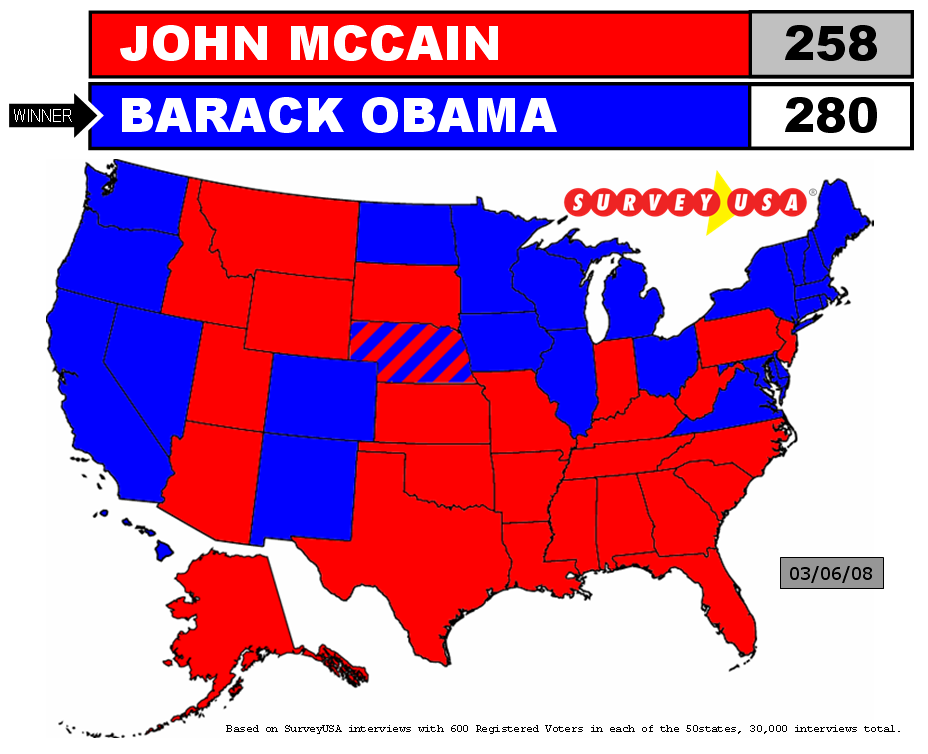
Clinton and Obama put together a very different collection of states. They get different red states in play, and they struggle in different blue states. But at the end of the day they both very narrowly beat John McCain in the electoral college vote, 280 to 258 for Obama and 276 to 262 for Clinton.

SUSA's polls confirm that, whatever the final match-up, the electoral map will not look like that of 2000 and 2004, and many states that were not that competitive in the past two contests (starting with Texas, but also Virginia, New Jersey) could be the top swing states this time around.

Before looking at numbers from the most interesting states, here are the two electoral maps, courtesy of SUSA:


As you can see, there are many differences between the two maps, and it is remarkable that both candidates come to roughly the same totals:

  • Once we weight the polls according to their state's size to get national numbers, Clinton leads 48% to McCain's 46%. McCain and Obama are tied at 46%.
  • The round-up of all 50 Clinton-McCain match-ups is here. The roundup for McCain-Obama match-ups is here.
  • States that only Clinton wins: Arkansas, Florida, New Jersey, Pennsylvania, West Virginia

  • States that only Obama wins: Oregon, Washington, Iowa, New Hampshire, Colorado, Virginia, North Dakota (!)
  • Red states that they both win: Only Ohio
It is evident from this list that Obama's strength is in the West: He comfortably keeps Oregon (+8%) and Washington (+14%) blue, two states Clinton loses (-5% and -2% respectively) and he carries New Mexico (by 7% versus 4% for Clinton). He then picks up Nevada (by 5%, while Clinton loses by 8%) and Colorado (by 9%, while Clinton loses by 6%).

All of this we are used to seeing, as Obama's edge in Western states like Washington and Colorado has been among the only consistent electability results over the past few months. But the extent of his advantage is considerable -- especially when we take into account the incredible fact that he puts the mountain states -- some of the reddest in the country -- in play! He narrowly wins North Dakota (Clinton loses by 19%), gets two out of five electoral votes in Nebraska, trailing 45% to 42% and loses South Dakota by only 4%!

But Obama is comparatively weak in the Northeast, and in many states are crucial for a Democratic victory come November: Clinton carries New Jersey by 5%, but Obama loses it in a tie at 43%. McCain continues to be competive in Massachusetts against Obama, trailing by 9% (18% against Clinton). In Pennsylvania, Clinton narrowly edges McCain by 1%, whereas the Republican beats Obama by 5%. An important exception is New Hampshire, in which Obama leads by 2% but Clinton trails by 8%.

Overall, it looks like McCain is succeeding in putting many traditionally blue states in play for his party: He is looking very strong in Pennsylvania and in New Jersey against both candidates, and he is competitive in other states in which both Democrats are leading, including places like Maryland and Delaware. Whoever the nominee is will have to move quickly to consolidate this region -- and if McCain manages to raise money quickly in the next few weeks he should try and build himself up in the Northeast before the Democratic candidate has a chance to counter-attack; it could be very damaging to Democratic chances in the fall.

But McCain is in danger in much of Red America -- or at least states that are must-wins for him. For one, he trails in Ohio by 10% against both Democrats. That's not a loss he can afford. Second, he is crushed in Florida by Hillary Clinton, 51% to 42% -- though he beats Obama 47% to 45%. It is very hard to imagine the Republican win the White House if he loses both Ohio and Florida. McCain's biggest nightmare could (unexpectedly) be... Texas! The poll shows McCain leading both Democrats by single-digits in the biggest red state of the country: He is up Obama 1% and up Clinton 8% -- and Hillary is weaker because she gets a low percentage of the black vote. Not a good sign for McCain.

There are other very worrisome numbers for McCain across the South: in South Carolina (where he is up 6% against Clinton and 3% against Obama), Tennessee (where Clinton ties him, though Obama is far) and North Carolina (he is up Obama only 2%, Clinton up 8%). In Virginia, a must-win for the Republican nominee, Obama ties him though he leads Clinton by 10%, though in West Virginia it is Clinton who conquers and Obama who stays back. In both Oklahoma and Kentucky, however, it is Clinton who gets within single digits. And if Hillary emerges as the Democratic nominee, McCain can kiss Arkansas -- her former home-state -- good-bye.

The Midwest, however, is yet another story, and McCain holds his own outside of Ohio. He survives with narrow leads in Missouri (+4% against Clinton, +6% against Obama). He holds both Democrats in single-digits in Minnesota, and he is very competitive in Michigan (he trails Obama by only 1% and ties Clinton). Michigan's 18 electoral votes flirted with Bush in 2000 and 2004 but they remained promised to the Democrat throughout those elections; this is not a state the Democratic nominee wants to have to think about.

Overall, both Democratic candidates have their weaknesses and strengths, and so does John McCain. Here is a regional summary -- and keep in mind that nearly all these lessons are confirmed by other polls we have seen recently:

  • The Big Three: Ohio and Pennsylvania have switched places, with the former appearing strongly Democratic and the latter a complete toss-up. Exchanging them does not do Democrats much good, and Florida seems as always all over the place -- with Clinton posting a strong lead and Obama trailing.
  • West: This is where Obama has his greatest potential to put McCain on the defensive in many red states (starting with NV and CO), while this is by far Clinton's weakest region (and she seems consistently unpopular in places like OR and WA) .
  • Northeast: Obama's most vulnerable region is also the one in which McCain appears to have the mots potential, as independents in many of these must-win blue states appear ready to flirt with the Arizona Senator (particularly New Jersey).
  • South: Between each other, the two Democrats put most of the states of this region within single-digits, testifying to McCain's weakness in red America.
  • Midwest: This region looks ready to be the nation's tightest area once again, with Missouri, Minnesota, Wisconsin and Michigan (and, of course, Ohio) all posting very competitive races.

Labels: , , ,

2.29.2008

Friday polls: Obama where he wants to be in Ohio and Texas, McCain looking strong in Florida

Whether or not the ad war is any reason for this, Obama is continually improving his position in March 4th polls. Keep in mind, Clinton will have to prove these polls wrong by winning both states and do so by big margins. First, two polls from Ohio:

  • A new Zogby poll shows a toss-up, in one of the closest polls from the state we have seen yet: Clinton is only ahead 44% to 42%.
  • ARG confirms that the gap is rapidly closing, showing a 50% to 45% margin in a poll taken over the past two days. Five days ago, ARG showed a 49% to 39% gap.
  • Update: Rasmussen confirms that Clinton has lost her Ohio lead, showing her ahead 47% to 45%. That's down from a 5% lead on Sunday night and a 9% lead last week.
If Clinton has to even worry about Ohio at this point, that leaves her even less time to focus on Texas, where her position looks even more dire:

  • Zogby shows Obama relatively comfortably ahead, 48% to 42%.
  • ARG has Obama up 51% to 44%, which is actually a one point improvement for Hillary (which is saying a lot). Clinton's lead among women (+9) and Hispanic (55-41) is much smaller than it should be, going a long way towards explaining her Texan troubles.

  • Meanwhile, the BELO Texas tracking poll shows Obama taking the lead for the first time, albeit only 46% to 45%.
In all of these polls, John McCain hardly looks to be in any danger against Mike Huckabee, which is a semi-surprise given that Huckabee was expected to maintain some semblance of competitiveness in Texas. But with the media having given up on the GOP race, it is not surprising that Huckabee is finding no space to continue making his case.

McCain got even better news with the release of a Mason-Dixon general election poll from Florida:

  • McCain leads Obama 47% to 37% and he leads Clinton 49% to 40%.
  • McCain posts strong numbers among Republicans, while both Democrats (particularly Obama) are much weaker among independents.
If these numbers are confirmed (and Florida hasn't been very kind to Dems over the past few months), it could spell trouble for the Democratic nominee who can't afford to give up on the Sunshine State's 27 electoral votes. (I am not suggesting that Democrats need to WIN Florida to get the White House, but that they need to force McCain to defend those 27 electoral votes, otherwise he would have too much time to spend not only on places he really can't afford to lose, like Ohio, but also testing the Democratic nominee in blue-leaning states). One possible reason for McCain's strength could be that he is likely to be stronger than other GOPers would have been among the Cuban community.

Labels: , ,

2.18.2008

Monday general election polls: Obama improving his electability, but can he restore his Florida (and Michigan) image?

Three general election polls were released this afternoon by SUSA and Rasmussen, and they show varying electability results, with Obama polling much better in Wisconsin and Minnesota and Clinton looking stronger in Florida:

  • In Minnesota, Rasmussen has McCain narrowly leading Clinton 49% to 43% but being trounced by Obama, 53% to 38%. Rasmussen provides an explanation: "McCain narrowly leads Clinton among unaffiliated voters but trails Obama by a two-to-one margin among those same voters."
  • The previous poll from Minnesota was released two weeks ago by SUSA and had Clinton running 3 points better than Obama, though both Democrats trailed McCain (though they crushed all other Republicans).

  • Rasmussen's Florida poll shows an inverse trend, with McCain leading Clinton 49% to 43% but crushing Obama by a much larger margin, 53% to 37%.
  • Obama only gets 55% of the vote of registered Democrats in Florida, 31% of which cross-over to McCain.

  • Finally, SUSA released a poll from Wisconsin which shows Obama running much better, trouncing McCain 52% to 42% while the Republican beats Clinton 49% to 42%.
  • The previous poll from the state, also released by SUSA two weeks ago, showed Obama and Clinton both narrowly trailing McCain, so the trendlines are good for the Illinois Senator within the same polling group here.
The Minnesota and Wisconsin polls suggest that Obama has significantly improved his electability position over the past three weeks, and general election surveys have never been as consistent on whether Obama or Clinton are the strongest contender as they have been over the past month. This trend has been correlated with Obama's improving fortunes in the Democratic primary, as both him and McCain have been receiving favorable media coverage as the two candidates that are emerging from bruising nomination battles. This explains why Clinton's trendlines have been decreasing in the same polls as Obama's has been improving (for example in SUSA's Wisconsin poll where Clinton lost 4 points in two weeks and Obama gained 12. The same is true in Rasmussen's daily national tracking.)

And then there is Florida, the swingiest of swing states. While the Democratic nominee does not have to win this state to win the White House -- it's much more of a must-win for Republicans -- they cannot afford to not be competitive in the Sunshine state, as that would be considered an unmistakable sign of weakness and would concede a huge bunch of electoral votes (I was about to write delegates) to John McCain. Now, the fact that Obama only gets 55% of registered Democrats clearly implies that the controversy over the state's delegates to the DNC convention is hurting the party. Since Clinton is the candidate who is trying to seat those delegates now, Obama is perhaps starting to look bad in the eyes of Florida Democrats, some of whom might be blaming him for trying to thwart their representation.

Even if Hillary emerges as the nominee, she will have to deal with the ridiculous chaos that this situation has created in Florida and repair the rift between her party and Floridians. And consider how much worse the situation will become if the Florida delegates are not seated after all, and there are no contingents from that state during floor votes and cuts of the crowd?

In fact, the same problem holds for Democrats in Michigan, and while there hasn't been a poll taken in that state for a while, the DNC better find a way to resolve this situation without making the Democratic nominee sweat it too much, unless they want to lose the state's electoral votes as well. Michigan has been voting reliably Democratic in recent cycles, but always by surprisingly tight margins, and this is as much of a must-win for Democrats as a swing state can get.

Labels: , ,

2.14.2008

As eyes turn to upcoming contests, Clinton looks like she could rebound

Facing the prospect of losing two more contests next Tuesday when Wisconsin and Hawaii go to the polls, Hillary Clinton appears to have decided to make an effort in Wisconsin. She installed Teresa Vilmain, who ran her Iowa campaign, to organize Wisconsin and she is planning on spending four days in Wisconsin starting on Saturday.

It is unclear whether the campaign thinks it can win in Wisconsin, but they have clearly realized that they cannot afford another 20+ loss, both because of the momentum it would give Obama in a two-week period with no elections and because the delegate lead would just keep widening. Polls suggest that Obama is narrowly ahead, but that Clinton is poised to keep this one close:

  • A new Rasmussen poll released this morning shows Obama leading 47% to 43%, up 23% among men and trailing 10% among women.
Balancing things in Wisconsin could allow Clinton to stay afloat in the final two weeks leading up to March 4th (and its two debates), and preserve her lead going into Ohio. The one public poll of the race for now suggested that she had a 17% lead, and two new surveys out this morning confirm the size of Clinton's lead right now:

  • Rasmussen has Clinton up 14%, 51% to 37%, boosted by a large lead among women.
  • Quinnipiac is even more favorable to Hillary, showing her to be ahead 55% to 21%. Obama is trailing by 26% among white men here, a constituency that has been looking better for him in other states.
The Quinnipiac poll was taken over the course of 6 days post-Super Tuesday, so it does not really incorporate the shifts that might have happened after Obama's latest string of victories, but Rasmussen's was in the field last night. Quinnipiac also released a poll from the Pennsylvania primary, which could prove decisive if Clinton survives March 4th. For now, she has an edge in PA too, leading 52% to 36%. Worth noting that both polls show huge educational gaps and racial gaps.

The challenge Clinton faces is that she cannot just narrowly win the three big contests that are coming up (OH, PA and TX), she needs to do so decisively to cut into Obama's delegate lead. She has not gotten that kind of margin anywhere but New York and Arkansas and, to some degree, in California, where her unexpectedly strong showing gave her an edge of more than 40 delegates. The good news for Hillary is that the events of the past few months have not made her fall in Ohio yet. A 14%+ victory there, if she can also pull off Texas, would surely give her enough momentum to continue and make a renewed case for Florida and Michigan.

  • General election
In conjunction with the primary polls I just mentionned, Quinnipiac also released general election polls in PA, OH and FL, three of the hottest swing states of 2008. All three states are close, confirming that they will once again decide this year's contest, and there is no clear electability difference between Obama and Clinton. If anything, she runs narrowly better than him, especially in Pennsylvania:

  • Against Clinton, McCain leads 44% to 42% in Florida, 44% to 43% in Ohio. He trails 46% to 40% in Pennsylvania.
  • Against Obama, McCain leads 41% to 39% in Florida, 42% to 40% in Ohio and trails 42% to 41% in Pennsylvania.
In all three of these states, Clinton runs significantly better than Obama among registered Democrats -- 15% better in Pennsylvania. And that is not a weakness Obama can necessarily rectify easily as time goes by, as McCain has shown capacity in appealing to moderate Democrats, a group that is not crossing-over if Clinton is their nominee. On the other hand, Obama runs stronger than she does among independents, and their respective weaknesses among indies and Dems offset each other. Now, McCain appeals to both of these groups. Clinton and Obama both defend one turf very well and are weak among the other. It is hard to imagine either doing well without the other group...

Labels: , , , , ,

12.05.2007

Evening polls: Quinnipiac polls the swing states, Clinton and Giuliani slide in New Hampshire

I have to find a way to report all the important polls without making every single entry I write poll-related. This was not a problem until this week, but now that we are getting a deluge of daily surveys I will have to find a way to do that. Bear with me in the meantime!

  • Quinnipiac polls the swing states
Quinnipiac came out with its wave of Florida, Ohio and Pennsylvania primary and general election polls. I will not comment on the primary polls here given that they are not particularly important in the primary process (except for Florida, where Giuliani gets 30% and is followed by Romney at... 12% and where Clinton crushes Obama 53% to 17%). So let's go straight to the general election:

  • In Florida, Hillary Clinton takes a comfortable lead against Rudy Giuliani, 48% to 41%. But Giuliani beats both Obama 45% to 37% and Edwards 43% to 39%.
  • Clinton wins all other match-ups comfortably as well: 47-40 to McCain, 52-36 to Thompson, 50-36 to Romney, and 50-35 to Huckabee.
  • A very interesting finding also is that Clinton has the highest favorable rating by far, at 52%. Her unfovarables are lower than the CW dictates, at 41%.
  • In Ohio, Hillary is on top of Rudy 45% to 41%. The other Democrats beat her as well: Edwards runs better than Clinton, winning 45% to 38%. Obama wins 42% to 38%.
  • Clinton crushes Thompson (47-38), Romney (47-37) and Huckabee (45-38), though she barely comes on top of McCain 44% to 42%.
  • In Pennsylvania, Clinton and Giuliani are tied at 44%. Clinton also ties McCain at 43%, while Obama and Giuliani tie at 41%.
  • Giuliani manages to beat Edwards 44% to 40%, but Clinton wins the three other match-ups: 49-37 to Thompson, 49-37 to Romney, and 48-37 to Huckabee.
Everyone obviously knows that these three states are The Big Three swing states of presidential elections in the past few cycles. If Democrats win two out of three, they are pretty much sure of winning the presidency. If they only win one, the road becomes tougher though not impossible if they pick up Iowa, New Mexico and a state like Missouri or Colorado.

It is interesting that Democrats look the weakest in the only state Kerry won in 2004 (Pennsylvania). The Florida poll must be very comforting -- it is likely that Republicans would not be able to recover the loss of these 27 electoral votes. But all in all, this wave confirms that 2008 will remain a close election; it starts leaning Democratic, but the GOP is hardly out of it.

One last note: It looks impossible to do an electability argument out of these polls other than say that Clinton has no problem being competitive in the general election (not that there isn't a ton of evidence for that already). She runs much better than Edwards and Obama in Florida, though that does not happen in OH.

  • Clinton and Giuliani's slide in New Hampshire
Two polls out of New Hampshire today have Clinton with a slim lead. One of them has her margin down to 6% -- the smallest we have seen since July:

  • The Washington-Post poll has Clinton at 35%, with Obama at 29%. Edwards is at 17% and Richardson at 10%.
  • The internal actually bring some good news for Clinton, who is widely seen as the most electable and the most prepared -- though Obama is viewed as the most honest by a small plurality. The most interesting stat might be that 53% of her supporters say they will "definitely" vote for her and 60% say they are "enthusiastic." The Post does not provide the exact numbers for Obama and Edwards yet, but they say that they have "much fewer" definite and enthusiastic backers. This could be a big help for Clinton if she collapses in Iowa.
  • The second poll is from Marist and has better news for Clinton who slightly expands her lead. She now is ahead 37% to 23%, with Edwards lurking behind at 18%.
  • Among Republicans, Romney gets 29% followed by McCain and Giuliani at 17%. Huckabee gets to 11%.
Now, this Marist poll is especially interesting since its last version (out on November 11th) was the first poll to show a dramatic Clinton collapse -- and it had started the storyline of Clinton's slide post-Philadelphia debate. Since then, things have solidified -- Clinton led 36% to 25%. Among Republicans, however, Giuliani was ahead of McCain 22% to 13% -- and this surge is also picked-up by the WaPo poll out yesterday which has McCain finally ahead of Giuliani.

Naturally, New Hampshire will be dramatically changed post-Iowa, and the five days before January 8th will see a very different picture. But the question Clinton will have to answer until then is: Can she use New Hampshire as a firewall, would her lead here survive if she lost Iowa? On the one hand, her margin is small at this point and would likely disappear -- on the other, she probably would not suffer a Dean-like collapse, since her support is much stronger. We shall see in three weeks!

Labels: , , , ,

11.20.2007

Morning roundup: Udall looks strong in New Mexico, Clinton not so much in Florida

  • Call it a pick-up
SUSA released a poll of the New Mexico Senate seat yesterday, and Tom Udall looks strong to pick-up the seat for Democrats, as he has big leads against his primary opponent and against Republicans:

  • In the Democratic primary, Udall beats Marty Chavez, Mayor of Albuquerque, 62% to 32%. Heather Wilson has the edge in the Republican primary against Steve Pearce (I believe this is the first poll we have seen of the GOP side), 56% to 37%.
  • Udall has double-digits leads against Pearce (54% to 40%) and against Wilson (56% to 41%).
  • But Chavez trails Pearce 52% to 42% and ties Wilson 47% to 46%.
New Mexico is currently ranked fourth on my latest Senate rankings, but that was before Tom Udall jumped in the race and made the race start leaning Democratic. This definitely has the potential of tightening up, but with so many seats to defend and in a financial hole, how much resources will the GOP be willing to spend here?

  • Florida leans GOP
Meanwhile, Republicans got some rare good news from a swing state poll, as all four candidates - yes, even Romney - handily defeat Hillary Clinton in Rasmussen's new Florida survey. And in even more of a twist, Rudy Giuliani is the weakest general election contender:
  • John McCain defeats Clinton 48% to 38%. Fred Thompson leads her 47% to 38%, compared to Romney's 46% to 39%. Surprisingly then, Giuliani is "only" ahead 46% to 41%.
  • In the Republican race, Rudy Giuliani is holding steady at 27%, but Mitt Romney has jumped up 8 points at 19%, ahead of Fred Thompson's 16% (down 7) -- very much in line with his national decline.
  • The Democratic race is much less interesting, as Clinton leads 42% to Obama's 17% and Edwards's 16%.
This is uncommon in Florida polls, as many polls (here is the latest SUSA survey) have shown Clinton leading in the state -- more consistently than, say, in Ohio. But the latest Quinnipiac poll had Democrats weakening in the Sunshine state against the GOP because of the primary controversy (the DNC has punished the "rogue state" and Florida Dems are sueing the national party, as the candidates are now avoiding the state). Could this be a second confirmation of that? If so, it proves what many people have said for weeks: Democrats are shooting themselves in the foot by punishing the major battleground states of Michigan and Florida.

  • Bill Clinton's value
Make sure to read the new Huffington Post/WNYC article I wrote and that was published this morning on Bill Clinton's value to the Hillary Clinton campaign. The first few paragraphs:
Pitchman Bill Clinton's e-mail promised contributors to his wife's campaign a chance to watch the Oct. 30 debate with him: "You, me, a TV, and a bowl of chips." Within five days, Hillary pulled in $170,000 in chunks of $200 and less, more than three times what she raised in the preceding five days. "Oh, we had a blast," David Monterosso, one of three chosen to watch the debate told Hillary, in a telephone call videotaped by the campaign. "And I made sure your husband ate some carrots."

In a similar ploy, a "Let's Do Lunch" e-mail earlier in September offered a select few a meal with the New York senator. Her offer, made during a slower time in the fundraising cycle, didn't match the money brought in by her husband, though a comparison of the five-day periods before and after shows a significant spike in small donations, from $23,000 to $121,000.

The campaign's decision to send out Bill's e-mail during the last days of the third quarter, when campaigns trot out their biggest fish, underscores that Bill is, in many ways, as powerful - and sometimes, more so - than Hillary on the campaign trail. Whether he would be an asset or a burden to his wife's campaign provoked talk at the start of the 2008 campaign. But with President Bush's deepening problems making the memories of the 1990s appear rosier than ever, the former First Lady's edge can be tied in very measurable ways to her husband's own popularity.

In a joint project by WNYC and OffTheBus, a team of researchers examined recent Federal Election Commission filings, traced connections of top Hillary backers to the Clinton Administration, and reviewed the minutia of Bill Clinton's schedule. They uncovered the unprecedented benefits of a former first lady tapping into her husband's connections, though the enthusiasm she generates among the Democratic base is so pronounced that much of it can only be attributed to her own appeal.

The wannabe First Man's presence on the campaign trail netted significant boosts in media coverage and in fundraising, but his value extends well beyond his direct campaigning. In fact, the roots of Hillary's campaign go deep in the electoral and fundraising machine the Clintons built in the 1990s, with support the power-couple enjoyed then carrying over to Hillary's presidential effort. Neither the Clinton campaign nor the Clinton Global Initiative answered our queries seeking their responses to this piece.

Labels: ,